Personnel Management N4 | June 2025 Final Exam Revision 1
Personnel Management N4
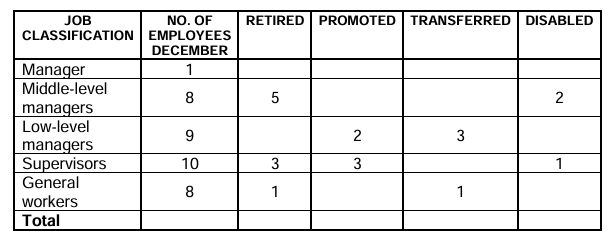
Use the information given in the TABLE below and answer the questions with regard to personnel movement by the end of December at Bosch Frozen Foods.
Question
How many people have to be recruited to fill vacancies for supervisors?
The number of supervisors who left their positions is the total of:
- Retired = 3
- Promoted = 3
- Transferred = 0
- Disabled = 1
Calculation:
3 (retired) + 3 (promoted) + 1 (disabled) = 7 supervisors left
Answer:
7 people need to be recruited to fill vacancies for supervisors.
Question
How many personnel members were promoted?
Promotions recorded in the table:
- Low-level managers = 2
- Supervisors = 3
- Other job levels show 0 promotions.
Calculation:
2 + 3 = 5 personnel promoted
Answer:
5 personnel members were promoted.
Question
How many employees retired during the year?
Retirements shown in the table:
- Middle-level managers = 5
- Low-level managers = 2
- Supervisors = 1
- General workers = 1
Calculation:
5 + 2 + 1 + 1 = 9 employees retired
Answer:
9 employees retired during the year.
Question
What is the total movement of personnel out of Bosch Frozen Foods?
Personnel movements include retired, promoted, transferred, and disabled.
From the table:
- Retired = 9
- Promoted = 5
- Transferred = 1 (Middle) + 3 (Low) + 1 (General) = 5
- Disabled = 1
Calculation:
9 (retired) + 5 (promoted) + 5 (transferred) + 1 (disabled) = 16 total movements
Answer:
16 employees moved out of Bosch Frozen Foods.
Question
Calculate the total number of posts at Bosch Frozen Foods.
According to the table:
- Managers = 1
- Middle-level managers = 8
- Low-level managers = 9
- Supervisors = 10
- General workers = 8
Calculation:
1 + 8 + 9 + 10 + 8 = 36 total posts
Answer:
There are 36 posts at Bosch Frozen Foods.
Question
Define the term organisational structure.
“Organisational structure is the way in which job tasks are formally divided, grouped and coordinated.”
This means how roles, responsibilities, and relationships are arranged within a company to achieve its goals effectively.
Question
State the SIX functions of an organisational structure.
“Keep the different parts together in a particular shape and relationship.”
The structure connects all departments so they function as a single unit.
“Give stability to the whole organisation.”
It ensures consistency and order in operations and authority.
“Keep the organisation logical and orderly.”
Tasks and responsibilities are clearly laid out to avoid confusion.
“Promote communication.”
It creates channels for effective communication across teams and levels.
“Support better coordination and control.”
Departments work together smoothly, and managers can oversee activities efficiently.
“Indicate method of delegation.”
It defines who reports to whom and how responsibilities are assigned.
Question
Differentiate between line structure and functional structure.
“Line structure is the traditional/simplest form of an enterprise structure.”
This type of structure has a clear chain of command where instructions flow from top to bottom, with each employee reporting to one superior.
“The functional structure is the traditional structure that develops as management sees the advantages of specialisation.”
In a functional structure, employees are grouped based on their area of expertise, such as marketing or finance, allowing for greater efficiency and skill use.
Question
State the following sources of recruitment:
(a) Internal sources:
Internal sources of recruitment include
“Job advertisements on bulletin boards or e-mails”
Organisations often advertise job openings within the company using bulletin boards or internal emails. This helps ensure that current employees have the first opportunity to apply.
“Personnel records will identify employees with the necessary competencies”
By reviewing existing employee records, management can identify individuals who already have the qualifications and experience needed for a vacant position.
“Skills inventories can identify whether a person can be allowed to move out of his/her present position.”
Skills inventories are databases that list employees’ abilities and qualifications. These can be used to decide if someone can be transferred or promoted into a different position.
(b) External sources:
External sources of recruitment include
“Employment agencies”
Employment agencies are specialised firms that help businesses recruit suitable candidates for vacant positions by screening and matching job seekers to employers.
“Headhunting/raiding”
Headhunting involves directly approaching and recruiting highly skilled professionals from other companies, especially when specific expertise is required.
“Walk-ins”
Walk-ins are job seekers who visit the organisation and apply for employment without prior invitation. This source is helpful when companies want to build a pool of applicants.
“Referrals”
Current employees may recommend people they know for available positions. Referrals can be trusted sources since the employee’s reputation is connected to the person they suggest.
“Professional associations”
These are organisations made up of members in the same profession. They often post job openings and connect employers with qualified professionals.
“Advertisements in newspapers, magazines and professional journals”
Print media remains a popular way to attract a wide range of job seekers by advertising available positions in newspapers and industry-specific publications.
“Campus recruitment”
Organisations visit colleges and universities to recruit students or recent graduates. This helps to bring in fresh talent and train them according to the company’s needs.
Question
When management wants to recruit new employees, they have to follow the process of recruitment.
Discuss the steps in the recruitment process.
“Assess the organisation in terms of attractiveness to potential employees.”
The company must ensure it appears as an appealing place to work, offering good benefits and work conditions.
“Obtain approval for a position in terms of necessity and budget.”
Before recruiting, management checks if the role is needed and whether there’s enough budget to hire.
“Update job description and the resulting job specification.”
The duties and required skills for the job are clearly defined and documented.
“Choose a recruitment medium and develop and place an advertisement with a closing date.”
A suitable platform (e.g., online job sites, newspapers) is selected to publish the job ad, with a set deadline for applications.
“Evaluate applications and compile a short list for initial interviewees and contact unsuccessful applicants.”
Applications are reviewed, top candidates are selected for interviews, and others are informed of the outcome.
“Notify successful applicants and make arrangements for the second interview.”
Chosen applicants are invited for follow-up interviews to further assess their suitability.
Public Administration N4 | Features of Parliament | National and Provincial elections
Question
Define organisational culture.
“It is the way in which things are done in an organisation.”
Organisational culture refers to the unique set of values, behaviours, customs, and beliefs that shape how things are done within a company. It influences everything from how employees interact with one another, how decisions are made, and how leadership is perceived. It is often invisible but deeply felt, and it gives every organisation its distinct “personality.” For example, some companies are fast-paced and competitive, while others focus more on teamwork and cooperation.
Question
Explain the factors that have an impact on the organisational culture.
“The organisational structure – how the employees feel about the rules, regulations and procedures and how they experience communication and the general atmosphere”
The organisational structure determines the level of hierarchy, formality, and how decisions are made. If the structure is too rigid, employees might feel restricted or unimportant, leading to low morale. A flexible structure allows for more freedom, innovation, and communication, creating a more positive working environment.
“Job responsibilities – how the employees experience being in charge of their own jobs”
When employees have clear roles and the authority to make decisions, they feel trusted and valued. This sense of ownership over their work increases responsibility and boosts motivation. On the other hand, if employees are micromanaged or unclear about their duties, it causes frustration and disengagement.
“Rewards – how employees feel about rewards they received, the emphasis on their positive or negative responses to work done”
The way an organisation rewards its employees strongly shapes its culture. If good performance is recognised with praise, bonuses, or promotions, it motivates employees to strive for excellence. However, if hard work goes unnoticed, workers may become demotivated or feel that their efforts don’t matter.
“Risks – the challenges that a job holds”
Risk-taking within a job can encourage creativity and problem-solving. In organisations where risk is supported and failure is treated as a learning opportunity, employees feel safe to innovate. In contrast, a culture that punishes mistakes leads to fear, hesitation, and limited growth.
“Warmth – the friendship and friendliness of co-workers”
A culture that promotes friendliness and warmth among colleagues leads to a more enjoyable work atmosphere. When people feel respected and supported by their teammates, it enhances cooperation and team spirit, which is essential for productivity and job satisfaction.
“Support – the amount of help which managers provide”
Managers play a key role in shaping culture. Supportive managers who provide guidance, feedback, and encouragement create a culture of trust and development. Employees feel valued and are more likely to perform well when they know leadership is accessible and helpful.
“Standards – the importance of doing work to a particular standard”
Culture is also defined by the expectations around work quality. High standards push employees to do their best and take pride in their work. However, if standards are too low or inconsistent, it can result in poor quality output and a lack of pride in the job.
“Conflict – the manner in which problems are handled by management”
How disagreements or issues are resolved speaks volumes about a company’s culture. A healthy culture promotes open dialogue and fairness. If conflicts are ignored or poorly managed, it can lead to resentment, mistrust, and division among employees.
“Identity – the feeling of belonging to a team and the importance that management places on team building”
When employees feel part of something bigger and believe in the mission of the organisation, it builds loyalty and purpose. A culture that promotes team identity and shared goals leads to stronger unity and commitment from employees.
“Leader/subordinate relationships – the most important characteristic of the culture”
The relationship between managers and staff defines how comfortable, motivated, and respected employees feel. Leaders who communicate openly, show appreciation, and involve staff in decisions build a positive culture where employees thrive.
Question
State the characteristics of each of the following:
(a) A close, threatening culture
“Output objectives are high.”
This culture expects employees to meet very high performance targets, often at the cost of well-being or job satisfaction.
“Responsibility for performing tasks remains with the individual doing the work.”
There is little collaboration; workers must carry out duties alone without much team support, which can feel isolating.
“It has a narrow span of control.”
Managers closely supervise only a few employees, leading to micromanagement and lack of independence.
“Emphasis is on individual performance and teamwork is not encouraged.”
Collaboration is discouraged. Instead, employees are judged mainly on their personal achievements, creating a competitive and often stressful environment.
“High productivity may be present, but workers are not motivated or satisfied with their working conditions.”
While employees might produce a lot, they often feel overworked, underappreciated, and disengaged.
“The organisation emphasises formal authority structures and consequently concentrates on functional units in isolation.”
There’s strict control with little interaction between departments. Employees often feel disconnected from the overall purpose of the organisation.
(b) An open, participative culture
“It is highly effective.”
Such a culture gets results because employees are engaged, supported, and included in the direction of the company.
“Motivation takes place by means of management objectives.”
Employees understand the company’s goals and align their work to meet them, feeling more focused and driven.
“Employees participate in decision making within teams.”
Decision-making is shared. Employees feel empowered and valued, leading to more innovative and committed performance.
“Authority is delegated to lower levels.”
Responsibility is shared, not just held at the top. This builds trust and encourages initiative among employees.
“Employees get rewarded for excellent performance.”
People are recognised and rewarded for doing well, which increases motivation and encourages continuous improvement.
“Communication is open and friendly.”
A safe environment is created where employees freely share ideas and feedback without fear of judgment.
“Conflict is handled effectively.”
Disputes are managed respectfully and fairly, preventing long-term resentment and promoting unity.
“Task enrichment is encouraged.”
Jobs are made more meaningful by giving employees more control, variety, or significance in their tasks.
“There is opportunity for job enlargement.”
Employees are given chances to take on more responsibilities, helping them grow and feel more useful.
“Employees have confidence in their leaders.”
Trust in leadership means workers believe in the direction of the company and feel secure in their roles.
“Employees are developed.”
The organisation invests in staff training and career growth, showing commitment to their long-term success.
Question
Name and explain the internal factors that influence human resources planning:
“Objectives of the enterprise: The objectives of the enterprise might be to grow in the future therefore manpower should be planned in advance.”
If a business plans to expand, it must ensure it has enough skilled staff to meet future demands. HR must recruit and train in advance to support this growth.
“Enterprise style: More emphasis is placed on the provision of employees who are compatible with the leadership style of the enterprise and its management team.”
The leadership style, whether democratic or authoritarian, affects the kind of employees who fit well. HR must match new hires with the organisational values and way of working.
“Nature of the task: Requires skills and knowledge within the enterprise, necessitates that management plan for recruitment and training of employees who will be able to carry out the required tasks.”
Some tasks require technical or specialised skills. HR must ensure the right training or recruitment strategy is in place so jobs are done efficiently and accurately.
“Work groups: It is necessary that teams work together. The communication method existing in the enterprise and the existing leadership styles will have an effect on the recruitment of employees.”
If teamwork is essential, HR must look for candidates who are good communicators and can work well in groups. It also means that team-building and collaboration are key in training programs.
Question
Name and explain the external factors that influence human resources planning:
“Trade unions: They can set requirements about the amounts and qualifications that prospective employees need to adhere to.”
Unions influence employee standards, such as wages, working conditions, and qualifications. HR must comply with union agreements to avoid disputes and maintain harmony.
“Government requirements and regulations: Many changing laws and ordinances in South Africa have to be adhered to by the enterprise when planning the right employees for employment.”
HR must follow labour laws, including employment equity, minimum wage, and safety regulations. These laws protect workers’ rights and shape hiring practices.
“Economic conditions: Enterprises need to adapt to the changing economic conditions that prevail.”
In times of economic growth, companies may hire more staff. In a recession, they may freeze hiring or reduce staff. HR must adjust plans based on the economy to ensure sustainability.
“Technological changes: Continuous changes in technology necessitate the training of existing employees or the employment of persons with the necessary qualifications.”
As new technology is introduced, the workforce must adapt. HR must invest in retraining existing staff or bring in new workers with updated technical skills to remain competitive.
Question
Explain the term compensation management.
“Compensation management is the management of a system where individuals are rewarded for their work, diligence and level of performance by means of pay and benefits.”
This refers to how an organisation designs, administers, and reviews employee pay structures. A well-managed compensation system ensures fairness, motivates employees, and helps attract and retain top talent.
Question
State and discuss the facets of compensation.
“Remuneration: To pay salaries according to the performance of employees”
Remuneration is the direct payment an employee receives, typically monthly or hourly. It’s often linked to their experience, role, and the quality or results of their work.
“Incentive schemes or bonuses: To motivate employees to do more”
These are additional financial rewards given for outstanding work. Bonuses encourage employees to exceed targets or take on extra responsibilities because they know their effort will be recognised.
Question
Name the benefits that employees may receive.
“Pension schemes.”
These secure employees’ futures by providing income after retirement, making long-term work more attractive.
“Personal security benefits”
Benefits like health insurance protect employees and their families in case of illness or injury.
“Personal needs”
Support for things like childcare, housing, or schooling helps employees manage their daily lives with less stress.
“Financial assistance”
Loans or grants can help employees during tough times or to pursue further studies or personal development.
“Company cars and petrol”
These perks reduce commuting costs and support job responsibilities, especially in roles requiring travel.
“Improvement of standard of living”
Together, these benefits enhance the overall quality of life, making employees feel cared for and loyal to the organisation.
Question
State the additional maintenance activities of the management team.
“Ensuring a quality work environment and social responsibility”
This means creating clean, respectful, and positive spaces to work in, while also ensuring the company gives back to the community.
“Ensuring a healthy and safe work environment”
Implementing safety rules, health checks, and wellness programmes to protect staff physically and mentally.
“Motivation of employees”
Keeping employees driven through recognition, career growth opportunities, and good working conditions.
“Provision of good leaders”
Selecting leaders who guide, inspire, and make fair decisions, which builds trust and direction.
“Structuring of groups”
Organising teams to work efficiently, with clearly defined roles and good communication systems for success.
Question
Name and explain the basic management tasks in full.
“Planning: Refers to deciding what the organisation is going to do.”
Planning is the starting point of all management activity. It involves setting clear goals and determining the best course of action to achieve them. Managers need to decide what direction the business will take, what resources will be needed, and what steps must be followed. Without proper planning, an organisation lacks direction and can struggle to achieve its objectives.
“Organising: Is deciding how the organisation is going to implement the plans it has come up with.”
Organising turns plans into action by arranging resources—such as people, money, and materials—so that they work efficiently together. This involves creating a structure, defining roles and responsibilities, and ensuring that everyone knows what to do and how their work connects to the bigger goal.
“Leading: Refers to ensuring that the human resources in the organisation are willing and able to implement the plans required to achieve its goals, after they have organised the resources needed to do this.”
Leading means motivating, guiding, and inspiring employees to do their best work. Managers must communicate the vision clearly, resolve problems, and ensure that the workforce stays engaged and committed. Good leadership turns plans into results by empowering people.
“Controlling: Is to measure how well the organisation is doing in implementing the plans that are in place, utilising all the resources that have been organised and providing leadership to the employees required to achieve its goals.”
Controlling ensures the organisation stays on track by monitoring progress and comparing actual performance with planned goals. If there are any gaps, corrective action is taken. This task helps maintain quality, efficiency, and accountability.
Question
Discuss the factors that can cause conflict in an organisation.
“A win-lose situation”
Conflict often arises when one party’s success is seen as coming at the expense of another. This competition breeds resentment, especially when employees feel their interests are not being considered or respected. In such situations, trust breaks down, and cooperation becomes difficult.
“Where two parties disagree on how to reach a goal”
Even when employees agree on what needs to be done, disagreements about how to do it can cause tension. Differing opinions on strategies, methods, or responsibilities can create friction unless open communication and compromise are encouraged.
“Where senior employees abuse their authority over juniors”
When managers or senior staff misuse their power—by being unfair, overly controlling, or dismissive—it can create a toxic environment. Junior employees may feel helpless or undervalued, leading to frustration, decreased morale, and resistance.
“Where two parties have different perceptions”
Conflict often arises not from facts, but from how people interpret them. If two people perceive a situation differently—for example, one sees feedback as helpful while the other sees it as criticism—this can cause misunderstandings and emotional tension.
“When changes are implemented and people feel threatened by it”
Change can create uncertainty and fear, especially if employees feel their roles, job security, or competence are under threat. Resistance to change is natural, but if not managed well, it can escalate into open conflict or passive resistance.
Question
Part of human resources planning is to do a skills inventory. What is a skills inventory?
“It is an analysis of the human resources situation of all current employees of the enterprise.”
A skills inventory is a detailed record that captures the qualifications, experience, strengths, and capabilities of every employee. It helps management understand what talent is currently available and where there may be gaps. This is essential for planning training, promotions, or future hiring.
Question
State the types of information that should appear in a skills inventory.
“Personal information”
This includes basic employee details such as name, age, contact information, and job title. It helps keep track of who holds each role and how to reach them.
“All training in the form of diplomas, degrees, certificate and courses”
Recording all formal education and training helps identify employees’ qualifications. It also shows areas where further learning or development may be needed.
“Complete service records of all previous employees”
This tracks the history of each person’s work experience within the company, such as previous positions held and years of service. It provides context for promotions or transfers.
“Results of performance evaluations and reports on promotional potential”
Performance reviews show how well employees are doing and identify high-potential individuals who could be promoted. This supports career development planning and fair recognition.
“Personal career prospects”
This includes employees’ own career goals or interests. Knowing what people want to achieve helps managers align personal aspirations with organisational needs.
Question
State the objectives of doing a skills inventory.
“Making a comparison between what is available in the enterprise in the form of labour and what is required.”
This helps managers see whether the current workforce has the skills needed to meet the company’s goals. If there’s a gap, they can plan for training or hiring to fill it.
“It identifies potential promotional material for the future.”
The skills inventory helps pinpoint employees who are ready to take on more responsibility. This makes promotion decisions more informed and fair, supporting employee growth.
“It creates opportunities for all to voice their aspirations and to make concrete plans in terms of planning their own individual development in the enterprise.”
By including personal development goals, a skills inventory empowers employees to shape their careers. It encourages them to grow and take initiative, while giving management insight into their ambitions.
Question
Selection forms an integral part of human resources provisioning.
What is meant by selection?
“Selection includes the use of application forms, curriculum vitae, interviews, employment and skills tests and reference checks to evaluate and screen candidates for a job from a pool of applications.”
Selection is the process of choosing the best person for a job from among many applicants. It involves carefully evaluating each candidate’s qualifications, experience, and suitability using various tools like interviews and assessments. The goal is to ensure the company hires someone who is not only skilled but also a good fit for the organisation.
Question
Fully explain the selection process that a company should follow.
“Applications are screened on the basis of completed job applications.”
This is the first step where unsuitable applicants are eliminated based on minimum criteria such as qualifications, experience, or clarity of application.
“An initial screening interview is held.”
Shortlisted candidates are invited for a basic interview to assess their general suitability, communication skills, and interest in the role. This helps further narrow the list.
“Assessment takes place to determine the skills of short-listed applicants and their ability to learn on the job.”
Candidates may complete practical or written tests to prove their competence. This shows whether they can handle the job’s technical demands or be trained quickly.
“Reference checks and background investigations are conducted.”
Employers contact former employers or other references to confirm the applicant’s past performance and reliability. They may also check criminal records or other background details.
“An in-depth interview is conducted by the manager to whom the applicant will report.”
The direct supervisor interviews the candidate to explore their work style, expectations, and whether they will fit well with the team. This is crucial for building a strong working relationship.
“A medical physical examination is conducted if appropriate.”
Some jobs require physical fitness or health screenings to ensure the candidate can safely perform their duties. This is usually job-specific, such as in security or heavy labour.
“An offer of employment is made.”
Once the best candidate is identified, a formal job offer is extended, including salary, benefits, and start date. The person becomes an official part of the organisation upon acceptance.
Question
Define delegation.
“Assigning formal authority, responsibility and accountability for the completion of specific activities to a subordinate.”
Delegation is when a manager entrusts a task or duty to someone lower in the hierarchy. It means giving the person the power to make decisions, the responsibility to get the work done, and being answerable for the outcome. Delegation helps managers focus on more strategic duties while empowering employees to develop and contribute more fully to the organisation.
Question
State the guidelines for effective delegation.
“The unity-of-command principle.”
This principle means each subordinate should receive instructions from only one superior. When too many people give conflicting orders, it causes confusion and inefficiency. Unity of command ensures clarity and accountability in the chain of command.
“A clear line of authority running from the highest to the lowest level of authority must be established (scalar principle).”
An organisation must have a well-defined structure where authority flows logically from the top to the bottom. This allows everyone to know who they report to and where they stand in the hierarchy, reducing uncertainty in task execution.
“Accountability must be assigned for specific tasks to the lowest organisational level.”
Tasks should be delegated to those closest to the action. This ensures decisions are made by people with direct knowledge of the work, which boosts efficiency and responsiveness. It also encourages responsibility and skill development among subordinates.
“The subordinate must be responsible for specific results.”
Delegation is not just about passing work down—it also means holding the subordinate accountable for outcomes. This clarity helps focus their efforts and encourages commitment to achieving the desired results.
“The subordinate must be given the freedom to choose the method and solution to carry out the task.”
Micromanaging defeats the purpose of delegation. Once the task and outcome are clear, the employee should have the autonomy to decide how best to achieve it. This not only builds trust but also encourages innovation and ownership.
“Open communication lines must exist.”
Continuous and clear communication between manager and subordinate ensures the task stays on track. It allows for updates, questions, and support, which are essential to success, especially when unexpected challenges arise.
“Specific tasks must be delegated.”
Delegation must be clear and targeted—vague or general instructions lead to confusion. Managers should define exactly what needs to be done so that subordinates can focus their efforts effectively.
“Specific subordinates must be assigned specific delegated tasks.”
Each task must have a clear owner. When multiple people are responsible, accountability becomes diluted. Assigning a task to a particular person ensures they take full responsibility for its completion.
“The assignment/task must actually be delegated.”
Some managers discuss tasks with subordinates without officially handing them over. True delegation involves transferring the actual authority and accountability—not just giving advice or instructions.
“A feedback system must be established.”
Feedback helps measure progress and performance. It allows managers to recognise success or make improvements where needed. A reliable feedback loop ensures quality, learning, and accountability throughout the process.
Question
State the barriers to delegation.
“When a manager is too disorganised or inflexible to delegate effectively.”
Some managers lack the structure or adaptability needed to pass tasks down. They may struggle to explain the task clearly, set deadlines, or trust others, making delegation ineffective or avoided altogether.
“When there is insecurity and confusion about who is ultimately responsible for a task.”
If it’s unclear whether the manager or subordinate holds final responsibility, both parties may hesitate. This leads to incomplete work, errors, or tension due to mixed expectations.
“When a manager must retain accountability for the actions of a subordinate.”
Even when tasks are delegated, managers remain accountable. This legal or professional responsibility can make them reluctant to delegate, especially if they doubt the subordinate’s ability to deliver.
“When the manager fears that his authority is reduced.”
Some managers avoid delegation because they think sharing tasks makes them look less powerful or important. This insecurity blocks growth for both the manager and the subordinate.
“When a manager is threatened by a subordinate’s success.”
If a manager sees a capable subordinate as competition, they may withhold opportunities to shine. This fear-based mindset creates a toxic environment and prevents talent development.
“When the subordinate wants to avoid responsibility and risk.”
Sometimes the subordinate resists delegation because they don’t want to be held accountable for mistakes. They may lack confidence or simply prefer to avoid the pressure that comes with ownership of a task.
Question
State the objectives of a human resources department.
“Ensure that all employees understand that an organisation employs unique individuals who each make an important impact on the organisation’s effectiveness.”
HR must promote inclusivity and respect by recognising that each employee contributes differently. This fosters a sense of value, motivation, and engagement across the workforce.
“Create a culture where both employees and the organisation focus on the same goals and objectives.”
The HR department ensures that staff goals align with company strategy. This shared focus builds teamwork, productivity, and a unified direction for growth.
“Support all managers in the execution of their tasks.”
HR assists managers by providing tools, training, and guidance for people-related matters—like hiring, discipline, or performance management—so managers can focus on operations.
“Ensure that the enterprise is properly staffed.”
This involves recruiting the right number and quality of employees at the right time. It prevents overstaffing or understaffing and keeps operations running smoothly.
“Develop the potential of every employee by means of training.”
HR is responsible for identifying skills gaps and arranging training to improve employee performance. This strengthens the business and shows staff that growth is possible.
“Retain staff by rewarding them for jobs effectively done.”
Employee retention is improved when staff feel appreciated. HR ensures that fair compensation, recognition, and growth opportunities are in place to keep valuable workers motivated.
“Be the link between management and employees regarding all matters.”
HR facilitates communication and resolves issues between staff and leadership. It plays a crucial role in maintaining a positive work environment and resolving disputes.
“Be the link between the external environment and the enterprise regarding all HR matters.”
HR also interacts with external bodies—like labour unions, government agencies, or job seekers—ensuring compliance with laws and staying updated on labour trends and regulations.
Question
State the steps of a method study.
“Divide tasks into their logical parts.”
Breaking down a task into smaller parts helps you understand how it works. It also makes it easier to see where delays or inefficiencies might occur.
“Collect all facts.”
This involves gathering data such as time taken, tools used, and worker movement. Accurate facts are the foundation for understanding how the task is currently performed.
“Critically evaluate the existing method.”
After collecting the facts, you must examine the current process to see what works and what doesn’t. Are there unnecessary steps? Are there bottlenecks? Evaluation helps pinpoint problems.
“Choose and develop an improved method.”
Based on the evaluation, a better way of doing the job is designed. This new method should save time, effort, or cost and increase output or quality.
“Write a report.”
Documenting the findings and recommendations helps communicate the changes clearly to decision-makers or other teams involved in implementing them.
“Implement the new method.”
This is where theory becomes practice. The new approach is introduced, often with training and support, to ensure a smooth transition.
“Maintain the new method.”
Ongoing monitoring ensures the new method continues to deliver the expected benefits. Adjustments may be made as needed to keep it efficient and relevant.
Question
State the objectives of a method study.
“Study the overall system.”
The goal is to understand how every part of the process interacts. A full-system view helps avoid fixing one issue only to create another elsewhere.
“Identify delays.”
Spotting where time is wasted helps improve productivity. This might include idle workers, machine downtime, or unnecessary waiting periods.
“Identify transport distances.”
Long or unnecessary movements between tasks waste time and energy. Reducing transport distances improves speed and worker comfort.
“Identify processes and processing time requirements.”
By measuring how long each step takes, managers can assess whether the time spent is justified or needs adjustment. It also helps in setting realistic expectations.
“Simplify the entire operation.”
The ultimate aim of a method study is to make work easier and faster. Simplicity leads to fewer errors, lower costs, and better results.
“Add value to the product or service.”
Improving the method should enhance the final output. Whether it’s reducing cost, improving quality, or speeding up delivery, the change must benefit the customer or organisation.
Question
Name and explain types of groups.
“Interacting groups: The work of one group is the input for another.”
Interacting groups rely on each other to complete tasks. One group’s output becomes the starting point for the next, creating a workflow chain. For example, a design team creates plans which the production team then uses. Success depends on good communication and timing between these groups.
“Coacting groups: Work carried out by one group does not influence the work of another group.”
In coacting groups, teams work independently without depending on one another. Each group completes their tasks separately, like sales teams working in different regions. These groups operate in parallel and their performance doesn’t directly affect the output of others.
“Counteracting groups: Groups on opposite sides work together to resolve differences.”
Counteracting groups are typically in conflict or disagreement but are required to work through their issues together. For example, labour unions and management might be in opposition but must negotiate and find middle ground to ensure business continuity.
Question
State the disadvantages of groups.
“The norms of the group may be different to the organisation’s.”
Sometimes group behaviour and shared beliefs can clash with the company’s values or objectives, leading to misalignment and conflict in the workplace.
“A group may be highly cohesive in a way that undermines the goals of the organisation.”
When a group is too tightly bonded, loyalty to the group may override loyalty to the business. This could lead to resistance to change or following their own priorities over company goals.
“A strong sense of solidarity could undermine the goals of the organisation.”
While unity is usually positive, excessive solidarity can create an ‘us versus them’ mindset, especially if the group starts rejecting external ideas or instructions from management.
“Decision making within the group may be slow.”
Groups often take longer to reach consensus because of discussions, disagreements, and the need to satisfy all members. This delay can affect efficiency and response time.
“Pressure to conform might have negative influence on some members of a group.”
Members may feel forced to agree with the majority, even if they disagree. This pressure can stifle innovation, reduce individual contributions, and cause stress or dissatisfaction.
“A few members of the group might dominate the rest of the group.”
Sometimes stronger personalities or those with more authority can take over, making decisions without true group input. This imbalance can lead to resentment and a lack of engagement from quieter members.
“Unless a group has a clear leader, no one person can be held responsible for the actions of the group.”
When leadership is unclear, accountability becomes a problem. If things go wrong, it’s difficult to identify who is responsible, which weakens control and performance monitoring.
“Group thinking may undermine the creativity of individuals.”
Groups may tend to agree too quickly to maintain harmony, a phenomenon known as “groupthink.” This can prevent individuals from offering new or opposing ideas, limiting creativity and innovation.
Question
What is human resources planning?
“It is the process of determining/deciding/estimating in advance what the correct number of employees are who possess the correct type of skills that are needed to do the various tasks in the enterprise, as well as deciding whether the tasks will be carried out or not.”
Human resources planning involves predicting the future needs of the business in terms of staff numbers and skills. It ensures the right people are available at the right time, avoiding both shortages and surpluses. It’s a strategic activity that supports organisational effectiveness by aligning workforce capacity with business goals.
Question
Name and explain the categories in which the activities of the human resources department can be divided.
“Human resources provisioning: This includes HR planning, job design inclusive of job analysis, job description and job specification, recruitment, advertising, selection, placement, induction and career development.”
Provisioning focuses on bringing the right people into the organisation. It covers everything from planning workforce needs, defining job roles, advertising positions, selecting candidates, and introducing them to the company. It’s the foundation of building a capable workforce.
“Human resources maintenance: This includes ensuring that the enterprise’s remuneration strategies are in line with the norm in the industry, development of incentive schemes and fringe benefits to increase job satisfaction and employee productivity; record-keeping regarding all HR matters; implementing health and safety regulations and maintenance of interpersonal relations and communication.”
Maintenance involves keeping employees satisfied and productive through fair pay, benefits, and a safe working environment. It also includes tracking HR records and ensuring open communication and good working relationships.
“Human resources utilisation: This ensures that employees fit the job that they have been employed for and motivating employees to maximum productivity levels in order to reach the goals of the enterprise.”
Utilisation means making the best use of employee skills by matching them with the right tasks. It also involves motivating staff to perform at their best, helping the business achieve its goals effectively.
“Human resources development: This includes all types of training; managerial development and succession planning.”
Development focuses on growing employee abilities through training and preparing future leaders through management development. It also includes succession planning to ensure continuity in key roles.
Question
State the activities that should be carried out during a human resources audit.
“Job analysis of all employees is done.”
This involves reviewing each employee’s job to ensure it matches their role, skills, and responsibilities. It helps to keep roles aligned with the company’s goals.
“Work performance is measured against job description.”
By comparing what employees actually do to what their job description says, HR can assess performance, identify gaps, and make improvements or adjustments as needed.
“The level of proficiency/quality of workers is investigated.”
This looks at how well employees perform and whether they meet expected standards. It highlights training needs and helps maintain high performance.
“Labour turnover and absenteeism is investigated.”
Frequent resignations or absences can signal deeper issues like poor morale or workload. Auditing these areas helps HR identify and address root causes.
“Internal movements of employees in the form of transfers and promotion are investigated.”
This tracks how often employees are moved or promoted and whether these decisions support the company’s growth and fairness in career progression.
“Current shortages are identified.”
HR audits help pinpoint where the business lacks skills or staff, allowing for timely recruitment or training interventions to fill those gaps.
Question
Give the reasons for career development.
“Ensure that the right people are available to meet staffing requirements.”
Career development prepares employees to fill roles as the business grows or changes. It ensures there are qualified staff ready for key positions when needed.
“Handle diversity of the workforce.”
By offering career paths suited to a wide range of backgrounds, career development helps manage a diverse team with different needs and aspirations.
“Provide employees with realistic job expectations.”
Career planning helps employees understand what roles involve, what’s expected of them, and how to succeed, reducing misunderstandings and dissatisfaction.
“Downsize, restructure or re-engineer enterprises due to mechanisation and computerisation.”
As technology changes the workplace, some jobs become redundant. Career development helps reskill employees so they remain valuable and employed within the business.
“Enterprises assist individuals who cannot realise their personal goals within the enterprise to find alternative employment.”
Sometimes employees’ goals no longer align with the business. Career support helps them move on positively, which maintains goodwill and avoids conflict.
“Realistic job and career opportunities to match the abilities and needs of individuals.”
People perform better when they’re in roles that fit their skills and ambitions. Career development matches individuals with the right paths to keep them motivated.
“Effective use of the workforce.”
When staff are placed in roles that suit them, productivity rises. Career development ensures the company is getting the most from its human resources.
“Reduce absenteeism.”
Employees who see a future in the organisation are more likely to be committed and present. Clear development paths improve attendance and morale.
“Lower staff turnover.”
When people grow and progress in their roles, they’re more likely to stay. Career development is a key strategy for retaining valuable employees.
“Improve morale among employees.”
Knowing there’s a plan for their growth boosts confidence and satisfaction. Career development encourages a positive work culture and loyalty.
“Ensure less wastage and a better organisational image.”
Well-planned career development reduces wasted potential and training resources. It also improves the company’s reputation as a good employer.
Question
State the facts that the management team should do to enhance self-development.
“Create career opportunities and advise employees about the various career paths that are available in the organisation.”
Management should guide employees by showing them the possible career routes within the company. This support helps staff make informed decisions and feel encouraged to grow.
“Match the goal of the individual with those of the organisation.”
Aligning personal goals with company objectives ensures mutual success. When both parties work toward shared outcomes, performance and job satisfaction improve.
“Ensure that career development is understood the same way by all parties.”
Everyone involved must have the same understanding of what career development involves. Clear communication ensures consistent expectations and fair opportunities.
“Ensure continuous support by periodically reviewing employee progress, by providing opportunities for self-study inside and outside the organisation.”
Ongoing check-ins, support, and learning opportunities help employees stay on track and motivated. This shows the organisation is invested in their long-term success.