EBM N4 June 2018 | Paper 1
EBM N4 June 2018 | Paper 1
Entrepreneurship and Business Management N4
Various options are given as possible answers to the following questions. Choose the best Answer
Question 1
1.1 Assets that can be changed quickly into cash:
A. Land and buildings
B. Stock
C. Equipment
D. Vehicle
B. Stock
Stock is a current asset and can usually be sold and converted into cash faster than fixed assets such as land, equipment, or vehicles.
1.2 Sources of secondary data:
A. Magazines
B. Surveys
C. Observations
D. Traffic counts
A. Magazines
Magazines are sources of information that already exist, so they are secondary data. Surveys, observations, and traffic counts are methods of collecting primary data.
1.3 The number of possible customers in a specific area:
A. Demographic segmentation
B. Geographic segmentation
C. Product positioning
D. Market share
A. Demographic segmentation
This is the accepted answer for this paper and should be learned exactly for revision of this exam.
1.4 An entrepreneur gets quick acceptance of a product and achieve a wide distribution in the market:
A. Market skimming
B. Premium pricing
C. Penetration strategy
D. Odd pricing
C. Penetration strategy
Penetration strategy aims at quick market acceptance and wide distribution, usually by making it easier for customers to buy the product early.
1.5 Hire purchase and leasing are examples of …
A. Short-term financing
B. Medium-term financing
C. Equity financing
D. Long-term financing
B. Medium-term financing
Hire purchase and leasing are medium-term financing methods because they are used over a period longer than short-term finance, but they are not permanent owner capital.
1.6 The money you put aside every year to replace fixed assets:
A. Reserve capital
B. Mark-up
C. Working capital
D. Depreciation
D. Depreciation
Depreciation is the yearly allowance made for the wearing out or loss in value of fixed assets, so that funds can effectively be set aside for replacement over time.
1.7 Products identified by a strong brand name:
A. Speciality products
B. Convenience products
C. Impulse products
D. Emergency products
A. Speciality products
Speciality products are strongly identified by brand name, and customers usually look for that exact brand rather than accepting substitutes easily.
1.8 Positive possibilities in the external environment:
A. Strengths
B. Weaknesses
C. Opportunities
D. Threats
C. Opportunities
Opportunities are positive possibilities found in the external environment. In SWOT analysis, opportunities and threats are external, while strengths and weaknesses are internal.
1.9 Potso sells bags at the flea market. She decided on a mark-up policy of 20% on all her products. She buys a bag for R80 and pays R20 for transport costs. What is the selling price:
A. R96
B. R100
C. R110
D. R120
D. R120
The total cost is R80 + R20 = R100. A 20% mark-up on R100 is R20. The selling price is therefore R120.
1.10 A product is made in one place with all raw materials being taken to that place:
A. Fixed position layout
B. Product layout
C. Process layout
D. Cellular layout
A. Fixed position layout
In a fixed position layout, the product stays in one place while workers, raw materials, and equipment are brought to it.
QUESTION 2
Identify the type of packaging, pricing strategy, product category or promotional strategy in each of the following pictures. Write only the answer next to the question number
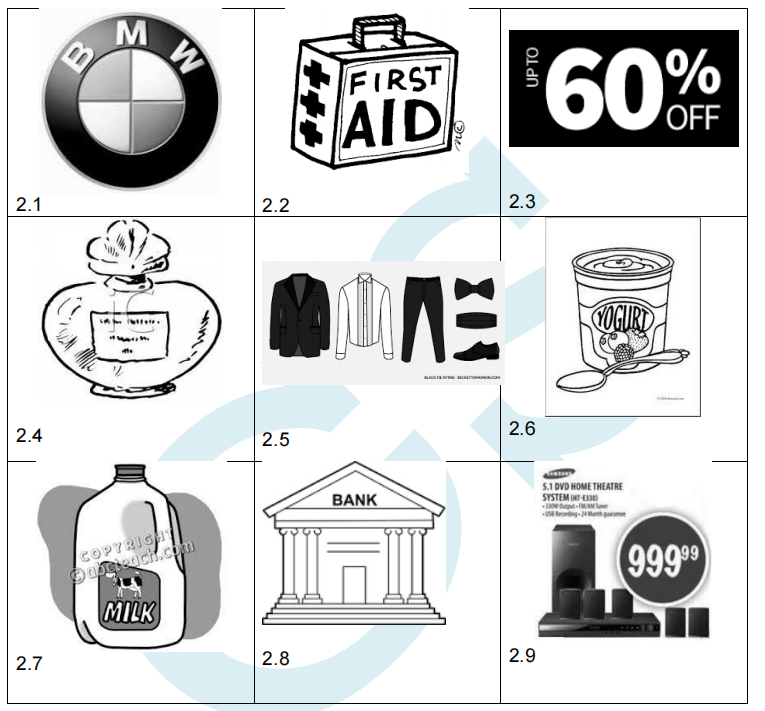
2.1 BMW logo
Speciality products
BMW is associated with a strong brand name, and customers often look for it specifically. That makes it a speciality product.
2.2 First-aid box
Emergency products
A first-aid box is bought for urgent or unexpected need, so it fits the category of emergency products.
2.3 “Up to 60% off”
Discount
This shows a reduced price, so the pricing method is discount.
2.4 Perfume bottle
Individual packaging
Perfume is packaged as a single separate item, so this is individual packaging.
2.5 Clothing items
Shopping products
Clothing is usually bought after comparing style, price, and quality, so it is a shopping product.
2.6 Yogurt container
Re-usable packaging
This packaging type can be used again after the product is finished, so it is re-usable packaging.
2.7 Milk bottle
Re-usable packaging
The milk bottle also fits re-usable packaging because the container can be used again.
2.8 Bank
Financial service
A bank provides a service linked to money and finance, so it is a financial service.
2.9 Price of 999.99
Odd pricing
Odd pricing uses prices such as 999.99 instead of rounding up, because it makes the price seem lower.
Question 3
3.1 List SIX demographic factors.
Age
Age is a demographic factor because customer needs and buying behaviour often differ across age groups.Gender
Gender is a demographic factor because businesses often study male and female markets separately when planning products and marketing.Location
Location matters because customers in different places may have different needs, access, and preferences.Occupation
Occupation influences income level, lifestyle, and buying behaviour, so it is an important demographic factor.Income
Income affects what customers can afford and which products or services they are likely to buy.Education
Education can influence understanding, preferences, and the way customers respond to products and marketing.
3.2 What is the definition of entrepreneurship?
Entrepreneurship is the process of creating a new business in the face of risk and uncertainty, with the purpose of achieving profit and growth, by identifying opportunities and assembling the necessary resources to use those opportunities well.