Life Sciences Grade 10: Section A Revision 1 | Q&A
Life Sciences Grade 10
Religion Studies Grade 10 : Study Guide | Past Paper Questions and Answers | Revision 2
Various options are given as possible answers to the following questions. Choose the best correct answer
Question: A Dutch scientist who designed the first microscope and is regarded as the father of microscopy:
A, Rudolf Virchow
B, Antonie van Leeuwenhoek
C, Robert Hooke
D, Matthias Schleiden
The correct answer is: B
Antonie van Leeuwenhoek was a Dutch scientist who designed the first microscope and is widely regarded as the father of microscopy because of his pioneering work in observing microscopic life.
Question: The diagram below shows enzyme action: What does Q represent in the diagram?
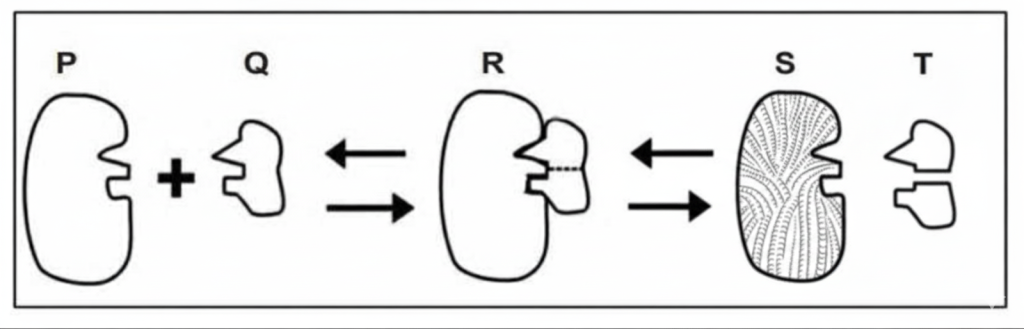
A, An enzyme
B, Enzyme-substrate complex
C, A product
D, Substrate
The correct answer is: D
In the diagram representing the “lock and key” model, Q is the substrate because it is the specific molecule that fits into the active site of the enzyme (P) before being converted into products (T).
Question: The most important function of the cell wall in a plant cell, is to…
A, prevent dehydration
B, allow certain molecules to pass through
C, keep unwanted solutions outside the cell
D, produce lignin to support the cell
The correct answer is: D
While the cell wall has several roles, its primary function is to provide structural support to the plant cell; in many cases, this involves the production of lignin to strengthen and support the cell’s structure.
Question: Which inorganic compound is most abundant in healthy bodies of plants and animals?
A, Vitamins
B, Water
C, Proteins
D, Carbohydrates
The correct answer is: B
Water is the most abundant inorganic compound found in living organisms, serving as a vital medium for chemical reactions and structural maintenance.
Question: The dark coloured body in the nucleoplasm of the nucleus:
A, Nucleus
B, Golgi apparatus
C, Ribosome
D, Nucleolus
The correct answer is: D
The nucleolus is a distinct, dark-colored structure located within the nucleoplasm of the nucleus and is responsible for producing ribosomal subunits.
Question: The most important function of the cell wall in a plant cell is to…
A, prevent dehydration
B, allow certain molecules to pass through
C, keep unwanted solutions outside the cell
D, produce lignin to support the cell
The correct answer is: D
While cell walls provide protection, their primary structural role is providing rigid support, often through the addition of lignin in mature cells.
Question: Which inorganic compound is most abundant in healthy bodies of plants and animals?
A, Vitamins
B, Water
C, Proteins
D, Carbohydrates
The correct answer is: B
Water is the universal solvent and makes up the majority (70%–90%) of the mass of living organisms.
Question: The dark coloured body in the nucleoplasm of the nucleus:
A, Nucleus
B, Golgi apparatus
C, Ribosome
D, Nucleolus
The correct answer is: D
The nucleolus is a dense region inside the nucleus responsible for the synthesis of ribosomal RNA (rRNA).
Question:The bond that forms between two amino acids is called a/an … bond:
A, Hydrogen
B, Peptide
C, Oxygen
D, Glycosidic
The correct answer is: B
Amino acids are linked by peptide bonds during protein synthesis to form long polypeptide chains.
Question: The reagent used to test for the presence of starch is:
A, Benedict’s solution
B, Ether
C, Iodine solution
D, Biuret solution
The correct answer is: C
Iodine solution changes from brownish-orange to blue-black in the presence of starch.
Question: Which of the following is a carbohydrate?
A, Glucose
B, Keratin
C, Steroid
D, Protease
The correct answer is: A
Glucose is a simple sugar (monosaccharide), whereas the others are proteins or lipids.
Question: A process in which molecules move from a high concentration to a low concentration until an equilibrium is reached:
A, Osmosis
B, Diffusion
C, Active transport
D, Phagocytosis
The correct answer is: B
Diffusion is the spontaneous movement of particles down a concentration gradient; osmosis is a specific type of diffusion involving only water.
Question: The organelle responsible for aerobic respiration is the:
A, Chloroplast
B, Vacuole
C, Mitochondrion
D, Ribosome
The correct answer is: C
Mitochondria are the “powerhouses” of the cell, where oxygen is used to break down glucose into energy.
Question: Which of the following elements is found in proteins but Not in lipids or carbohydrates?
A, Carbon
B, Hydrogen
C, Oxygen
D, Nitrogen
The correct answer is: D
Proteins consist of amino acids, which contain an amino group , making Nitrogen a defining element of proteins.
Question: The cell membrane is described as being:
A, Completely permeable
B, Impermeable
C, Selectively permeable
D, Rigid
The correct answer is: C
The cell membrane controls what enters and leaves the cell, allowing only specific substances to pass through while blocking others.
Question: Which is the primary structural component giving the plant cell wall its rigidity?
A. Pectin
B. Cellulose
C. Lignin
D. Hemicellulose
Correct Answer: B
Cellulose forms strong microfibrils (beta-linked glucose polymers) that provide tensile strength and rigidity to the cell wall, enabling plants to stand upright. Lignin (Option C) waterproofs and hardens secondary walls in vascular tissues.
Give the correct biological term for each of the following description
1, Part of the microscope that concentrates light rays from the light source onto the specimen:
The correct answer is: Condenser / diaphragm.
The condenser is a lens system located beneath the stage that focuses light into a concentrated beam to ensure the specimen is properly illuminated for high-resolution viewing.
2, Deficiency caused by lack of iodine in humans:
The correct answer is: Goitre
Iodine is essential for the thyroid gland to produce hormones; a deficiency causes the gland to swell, creating a visible lump in the neck known as a goitre.
3, Organic compounds made up of the elements C, H, O and N:
The correct answer is: Proteins
Proteins are built from amino acids. While carbohydrates and lipids contain Carbon, Hydrogen, and Oxygen, proteins are distinguished by the mandatory presence of Nitrogen.
4, Fats mainly derived from plants, that are liquids at room temperature:
The correct answer is: Unsaturated fats / Oils
Unsaturated fats have double bonds in their chemical structure that prevent the molecules from packing tightly together, keeping them in a liquid state at room temperature.
5, The movement of water molecules from a high water potential to a low water potential through a selectively permeable membrane:
The correct answer is: Osmosis
Osmosis is a passive transport process specific to water molecules moving across a membrane to balance concentration levels on both sides.
6, The bond that forms between two amino acids:
The correct answer is: Peptide bond
During protein synthesis, a dehydration reaction occurs between the amino group of one amino acid and the carboxyl group of another, forming a peptide bond.
7, A pigment found in the chloroplast of a plant cell that traps radiant energy:
The correct answer is: Chlorophyll
Chlorophyll is the primary pigment in plants that absorbs light energy, specifically from the blue and red ends of the spectrum, to drive the process of photosynthesis.
8, The structural and functional unit of all living organisms:
The correct answer is: The Cell
According to the Cell Theory, the cell is the smallest unit of life that can perform all biological functions independently.
9, The reagent used to test for the presence of glucose:
The correct answer is: Benedict’s solution
When Benedict’s solution is added to a substance and heated, it changes from blue to green, yellow, or brick-red depending on the concentration of reducing sugars like glucose.
10, The movement of molecules against a concentration gradient using energy.
The correct answer is: Active Transport
Unlike diffusion, active transport requires the cell to expend energy to pump molecules from an area of low concentration to an area of high concentration.
11, The substance that gives the plant cell wall its rigid structure:
The correct answer is: Cellulose
Cellulose is a complex carbohydrate (polysaccharide) that forms tough fibers, providing the structural strength needed for plant cell walls.
12, Organelles that are the site of protein synthesis:
The correct answer is: Ribosomes
Ribosomes translate genetic code from mRNA into chains of amino acids to create proteins; they can be found floating freely or attached to the Endoplasmic Reticulum.
13, The maintenance of a constant internal environment in living organisms:
The correct answer is: Homeostasis
Homeostasis is the process by which biological systems maintain stability (like body temperature or pH) while adjusting to changing external conditions.