Life Sciences Grade 10 Revision 2 | Past Paper Questions & Answers Explained
Life Sciences Grade 10
Religion Studies Grade 10 : Study Guide | Past Paper Questions and Answers | Revision 2
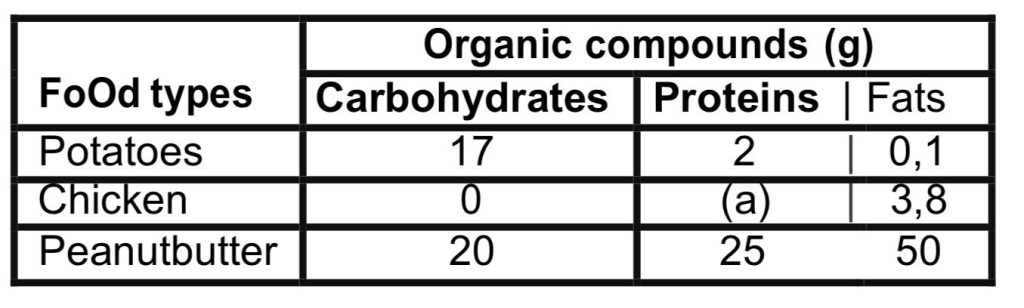
The table below shows amounts of different types of food eaten by a learner and organic compounds. The total of organic compounds she ate is 144,9 grams
Question : Organic Compounds in Food
The table shows the amounts of carbohydrates, proteins, and fats found in different foods eaten by a learner. The total mass of organic compounds consumed is 144.9 grams.
Question: Identify the food type that is made mostly of fats.
The food type that is made mostly of fats is peanut butter.
From the table, peanut butter contains 50 grams of fats, which is far higher than its carbohydrate (20 grams ) and protein (25 grams ) content. This shows that fats are the main organic compound present in peanut butter.
Question: State the monomers of fats.
The monomers of fats are fatty acids and glycerol.
Fats are complex molecules that are broken down during digestion into fatty acids and glycerol. These smaller units are absorbed by the body and used for energy storage, insulation, and cell structure.
Question: Calculate the value of A, Show all working.
We follow the steps below to calculate the value of A.
Firstly we been given the Total organic compounds eaten = 144.9 g
Step 1: Calculate the total known mass from the table
For Potatoes we have:
Carbohydrates = 17 g , Proteins = 2 g , Fats = 0 .1 g , giving us a Total of 19. 1 g
For Chicken (excluding protein A) we have
Carbohydrates = 0 grams, Fats = 3 . 8 g giving us a total of 3.8 g
For Peanut butter we got, Carbohydrates = 20 g, Proteins = 25 g, Fats = 50 g giving a total of 95 g
Therefore the Total known mass is 19 .1 g + 3 .8 g + 95 g which gives a total of 117 .9 g
Step 2: Calculate the missing value (a)
144 point 9 g – 117 . 9 g = 27 g
Hence The value of A, = 27 g
Question: Give the chemical reagent used to test for proteins.
The chemical reagent used to test for proteins is Biuret reagent. (Millon’s reagent can also be used)
When Biuret reagent is added to a substance containing proteins, the solution changes from blue to purple, confirming the presence of proteins.
Question: Explain the colour change when a starch test using iodine is done on the potatoes.
When iodine solution is added to potatoes, the colour changes from brown to blue-black.
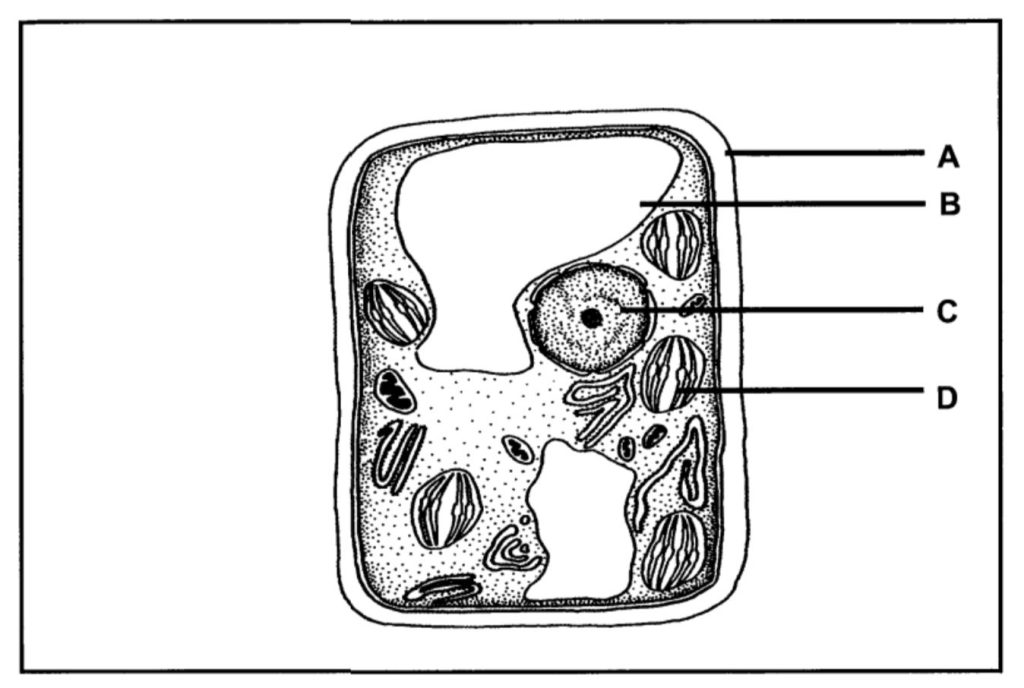
The diagram below shows a plant cell
Question: Name the useful substances that part B contains
Part B represents the vacuole. The vacuole stores useful substances such as sugars, which are used as an energy source, minerals, which support various metabolic processes, and pigments dissolved in water, which may contribute to colour in plant tissues and help attract pollinators.
Question: State the function of part C
Part C represents the nucleus and performs the following functions
1, The nucleus controls the activities of the cell by acting as the control centre. It regulates important processes such as growth, metabolism, protein synthesis, and cell division, ensuring that the cell functions properly.
2, The nucleus also transmits hereditary characteristics from parents to offspring. It contains DNA, which carries genetic information responsible for inherited traits. During reproduction, this genetic material is passed on, ensuring continuity of characteristics across generations.
Question: Give the Letter and the Name of the part that is selectively permeable
The selectively permeable structure in the plant cell is labeled A, and it is called the cell membrane. The cell membrane controls the movement of substances into and out of the cell, allowing essential materials such as oxygen, water, and nutrients to enter while preventing harmful substances from passing through freely.
This selective permeability helps maintain a stable internal environment within the cell. By regulating the exchange of materials, the cell membrane ensures that cellular processes occur efficiently and that the cell remains healthy and function.
Question: Explain the advantage for this cell having many part D’s
Part D, represents the chloroplasts. Having many chloroplasts increases the rate of photosynthesis in the cell. More chloroplasts mean that a larger surface area is available to absorb light energy, which allows the plant to produce more glucose for energy and growth.
Chloroplasts contain chlorophyll, which traps light energy needed for photosynthesis. When a cell has many chloroplasts, it can manufacture more food, supporting faster growth and providing energy for other life processes of the plant.
Question : Cell Structure
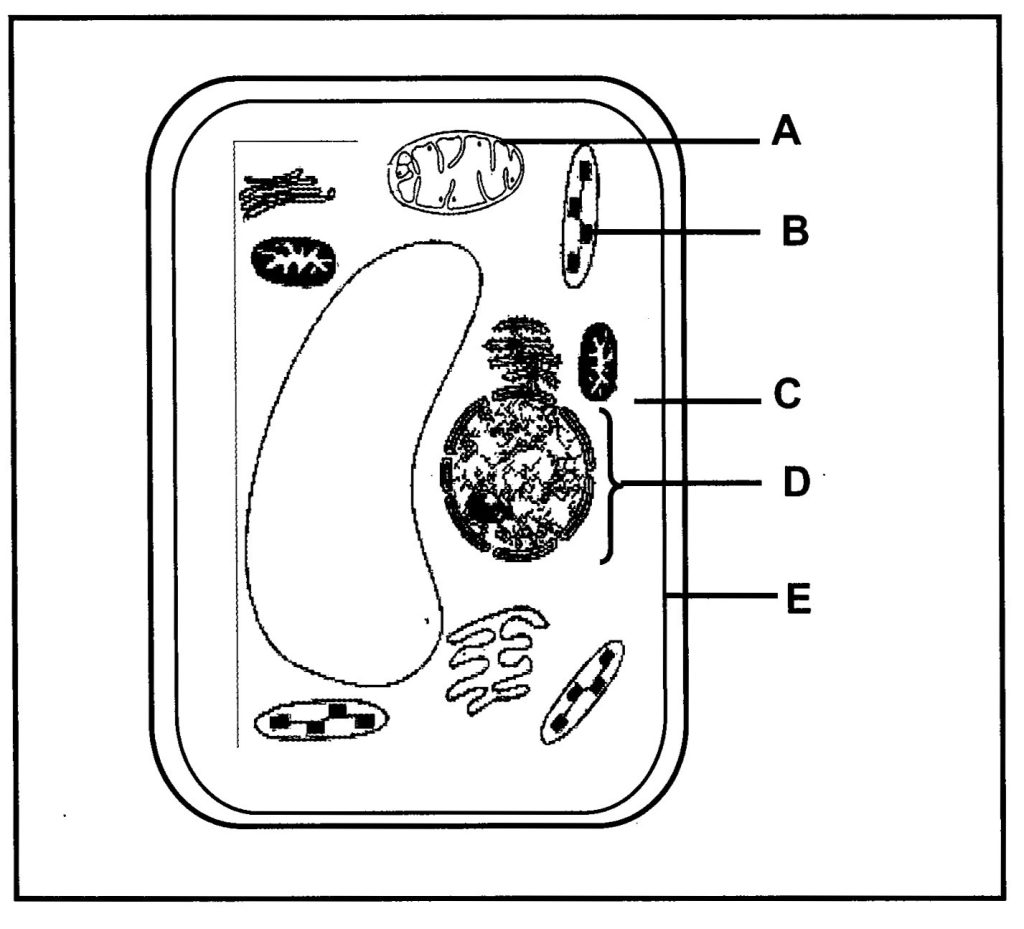
The diagram below represents the cell structure.
Question: Does the diagram represent a plant cell or an animal cell?
The diagram represents a plant cell. This is evident because it contains structures that are unique to plant cells and are involved in support and food production.
Question: Give Three visible reasons why the cell is a plant cell.
One visible reason is the presence of a cell wall, which provides strength and support to the cell. Animal cells do not have a cell wall.
Another visible reason is the presence of chloroplasts, which contain chlorophyll and are responsible for photosynthesis. Chloroplasts are found only in plant cells.
A third visible reason is the presence of a large central vacuole, which stores water and dissolved substances and helps maintain the shape of the cell. Animal cells do not have a large permanent vacuole.
Question : Identify part C in the diagram.
Part C is the cytoplasm. The cytoplasm is a jelly-like substance that fills the cell and holds all organelles in place. Most metabolic reactions in the cell occur in the cytoplasm.
Question: Identify part E in the diagram.
Part E is the cell membrane. The cell membrane surrounds the cytoplasm and controls the movement of substances into and out of the cell.
Question: Give the Letter of the part that controls cell activities.
The letter is D. Part D represents the nucleus, which controls all cell activities and contains the genetic material of the cell.
Question: Give the Letter of the part that releases energy during cellular respiration.
The letter is A. Part A represents the mitochondrion, where glucose is broken down using oxygen to release energy for the cell.
Question: Describe how part E is adapted to its function.
Part E, the cell membrane, is selectively permeable. This means it allows certain substances such as oxygen and nutrients to enter the cell while preventing harmful substances from entering, thereby maintaining a stable internal environment
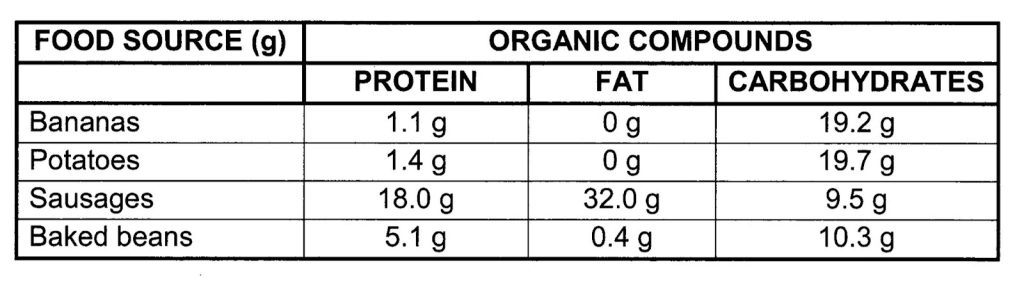
The table below shows nutritional information for some common food sources and organic compounds.
Question: Name the food source that would be best suited to provide high amounts of energy.
Potatoes are the best food source for providing high amounts of energy. This is because potatoes contain a large quantity of carbohydrates. Carbohydrates are broken down into glucose during digestion, and glucose is used by cells during respiration to release energy.
Question: Name the food source that has the least amount of protein.
Bananas have the least amount of protein. They contain only small quantities of protein compared to the other foods listed. Bananas mainly supply carbohydrates and vitamins rather than building nutrients such as proteins.
Question : Write down Two organic compounds that are found in high amounts in sausages.
Sausages contain a high amount of protein. Proteins are needed for growth, repair of body tissues, and the formation of enzymes and hormones. Since sausages are made from animal tissue, they naturally contain large amounts of protein.
Sausages also contain a high amount of fats. Fats provide long-term energy, help insulate the body, and protect internal organs. Processed meats such as sausages often have added fats, increasing their fat content.
Question: What are the monomers of proteins?
The monomers of proteins are amino acids. Amino acids are small molecules that join together in long chains to form proteins. The sequence and type of amino acids determine the function of each protein.
Question: Name the chemical reagent used to test for proteins.
The chemical reagent used to test for proteins is the Biuret reagent. When the Biuret reagent is added to a food sample containing protein, it changes colour from blue to purple. This colour change occurs because the reagent reacts with peptide bonds in proteins.
Question: Describe how to test for the presence of starch in a food sample.
To test for starch, a few drops of iodine solution are added to the food sample. If starch is present, the iodine changes colour from brown to blue-black. If the colour remains brown, it shows that starch is absent from the sample.
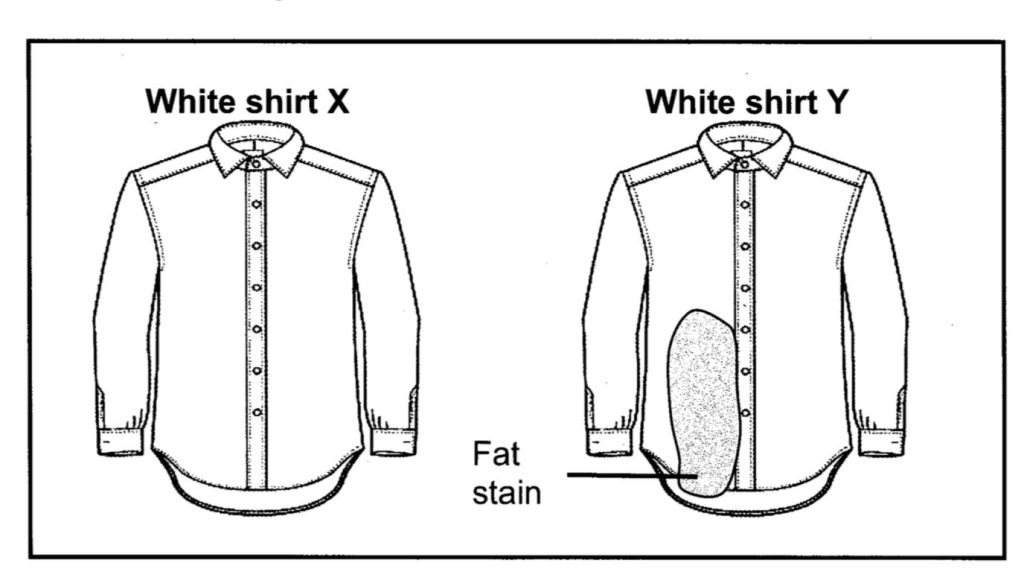
An investigation was carried out to determine the effect of high temperature on a washing powder containing fat-digesting enzymes.
The procedure was as follows:
- Two same school white shirts were used.
- White shirts X and Y had same fat stains.
- White shirt X was washed using detergent containing fat-digesting enzyme for 3 minutes at 3 7 °C.
- White shirt Y was washed using a detergent containing fat-digesting enzymes for 3 minutes in boiling water.
- The investigation was repeated five times.
The results of the investigation are shown below
Question: Identify the dependent variable
The dependent variable in this investigation is the extent to which the fat stain is removed from the shirt. This variable represents the outcome being measured to determine how effective the enzyme can be, or is under different temperature conditions.
Question: Identify the independent variable
The independent variable in this investigation is the temperature of the water used during washing. This variable was deliberately changed to observe its effect on the activity of the fat-digesting enzyme.
Question: State Two factors that were kept constant during the investigation
The type of shirt used was kept constant to ensure that differences in fabric did not influence how easily the stain was removed.
The washing time of three minutes was kept constant so that the duration of enzyme exposure did not affect the results.
Question:Explain why white shirt X was included in the investigation
White shirt X was included as a control in the investigation. It provided a standard condition at 37 °C against which the effect of boiling water could be compared.
Question: Explain why the investigation was repeated five times
The investigation was repeated five times to increase the reliability of the results. Repetition helps to reduce the influence of random errors and ensures consistent findings.
Question: State a conclusion for this investigation
The investigation concludes that high temperatures reduce the effectiveness of fat-digesting enzymes. Boiling water causes enzymes to lose their structure and become unable to break down fats.