History Grade 12 Spheres Of Interest
Spheres Of Interest
SOURCE 1A
The source below explains the United States of America’s intention to contain the spread of communism in Europe from 1947 onwards.
| … United States officials in 1947 and 1948 did not have precise (specific) ideas about how to implement containment. Should containment be applied everywhere? Should it be applied militarily? Should the United States focus on economic aid to nations seeking to reconstruct their economies? Should the United States assign priority to occupation policies, especially in Germany and Japan? Initially, in what became known as the Truman Doctrine, the United States president proposed military aid to Greece and Turkey, and declared that the United States would contest totalitarian expansion everywhere. But his subordinates quickly recognised that they had to calculate priorities carefully. They decided that they should focus on economic reconstruction in Western Europe rather than military rearmament; that they should seek to erode (wear down) support for communist parties in France, Italy, and Greece; that they should manage the revitalisation (recovery) of Western Germany and Japan, and co-opt (choose) their future power. Containment meant that Soviet influence and communist ideology should be contained within the areas occupied by the forces of the Soviet Union at the end of World War II. In June 1947, the United States announced the Marshall Plan to help rebuild Europe. The governments of most Western European nations were happy to receive US money and participate in a reconstruction programme. But they possessed deep fears about the revival of German power. In order to get the French to cooperate, the United States promised to retain its occupation forces inside Germany. |
Refer to Source above and answer questions that follow
Question
Explain the term containment in the context of the Cold War.
Containment was a strategic policy introduced by the United States during the Cold War era to stop the spread of communism across Europe. The policy was based on the belief that communist ideology, championed by the Soviet Union, posed a direct threat to democratic and capitalist systems. The aim of containment was to prevent communism from spreading beyond its current borders, limiting Soviet influence without direct military confrontation.
The containment strategy was embodied in two major U.S. initiatives:
- The Truman Doctrine: This was a declaration that the U.S. would support nations threatened by Soviet influence or communist insurgency, initially directed at Greece and Turkey.
- The Marshall Plan: This economic program offered financial aid to war-torn European countries to help them rebuild and stabilize their economies, with the aim of reducing the appeal of communism in impoverished and unstable regions.
Together, these initiatives exemplified the U.S.’s commitment to curbing the expansion of communism through economic and diplomatic means rather than solely military force.
Question
State THREE ways in the source that the United States of America could have used to implement the policy of containment.
Answer:
- Applying containment universally, including militarily: The U.S. could enforce containment on a global scale, involving military presence or intervention where necessary to support allies and prevent communist influence from spreading, especially in vulnerable regions.
- Focusing on providing economic aid to nations rebuilding their economies: By offering financial support through programs like the Marshall Plan, the U.S. could help European countries recover from the devastation of WWII. This would create strong, resilient economies less susceptible to communist ideology, which often gained traction in impoverished areas.
- Prioritizing occupation policies, especially in strategic areas like Germany and Japan: The U.S. maintained occupation forces in these key regions, which allowed them to directly influence local governments and economies, ensuring they remained aligned with democratic and capitalist principles rather than succumbing to Soviet influence.
Question
Using the information in the source and your own knowledge, explain how the economic reconstruction of countries in Western Europe could have benefitted the economy of the United States of America in the late 1940s.
Answer:
The economic reconstruction of Western European nations, primarily through the Marshall Plan, would not only stabilize these countries but also foster stronger trade relationships with the United States. A more prosperous Europe would need American goods, services, and raw materials for its industries and consumer markets, thus expanding export opportunities for U.S. companies. This influx of European demand would, in turn, stimulate U.S. economic growth, create jobs, and strengthen the capitalist economic system that the U.S. was promoting worldwide.
Furthermore, a stable Europe meant a reliable economic and political ally for the U.S., enhancing its influence in global affairs and ensuring a market-driven alternative to the communist system promoted by the Soviet Union.
Question
Comment on the usefulness of the information in this source to a historian researching the USA’s policy of containment.
Usefulness of Source 1A:
- Insight into U.S. Policy and Strategy: The source provides valuable context about the USA’s initial approach to containment, including the challenges and strategic considerations faced by American policymakers. It illustrates how containment evolved from a vague concept to a structured policy framework involving both military and economic dimensions.
- Details on the Truman Doctrine and Marshall Plan: By highlighting these two initiatives, the source clarifies the specific mechanisms of containment. The Truman Doctrine signaled a commitment to aid nations against communist threats, while the Marshall Plan used economic aid to rebuild and stabilize Europe, directly aligning with containment goals.
- Diplomatic and Military Strategies in Europe: The source references U.S. actions in occupied Germany, showcasing the role of American troops as a deterrent against potential Soviet expansion. This detail underscores the U.S.’s emphasis on maintaining a strong presence in strategically significant regions to support containment.
- Western Europe’s Acceptance of U.S. Aid: The source also sheds light on Western Europe’s openness to U.S. economic assistance, which was crucial for strengthening alliances and shaping a pro-U.S. bloc in Europe. This acceptance was a key factor in the success of containment, as it showed that economic dependency could foster loyalty and resist communist influence.
SOURCE 1B
The source below highlights the role that Dean Acheson, Deputy Secretary of State during George Marshall’s administration, played in influencing the United States Congress to adopt Truman’s policies in 1947.
Question
List two institutions from the source that Dean Acheson helped to shape during Truman’s Cold War.
- Dean Acheson played a key role in shaping both the political institutions and economic institutions during Truman’s Cold War. These institutions were essential in defining the U.S. strategy to counter communist influence globally and to structure foreign policy in response to Cold War pressures.
Question
Why do you think the U.S. Congress was initially unwilling to provide aid to the Turkish and Greek governments?
- The U.S. Congress was hesitant to approve aid for Turkey and Greece due to its focus on financial discipline. At the time, Congress was cautious about spending large sums abroad and was concerned about the economic impact of committing funds to foreign aid.
- Additionally, Congress was wary of deeper involvement in European affairs, as many legislators believed it was not America’s role to intervene in overseas conflicts or crises not directly impacting U.S. interests.
Question
Explain how Acheson managed to convince the U.S. Congress to support both Turkey and Greece with aid.
- Acheson reframed the crisis in Turkey and Greece as a key Cold War confrontation rather than a local issue, arguing that the Soviet Union’s actions in these countries reflected a broader struggle between communism and democracy.
- He warned Congress that if Turkey and Greece fell to communism, it would lead to a “domino effect,” threatening Iran, African countries, and other European nations like Italy and France, which were already facing communist pressures.
- Acheson argued that only the United States could prevent this communist spread, positioning the U.S. as the essential force to block what he called a “communist onslaught.”
- His impassioned speech, which emphasized the stakes as a choice between freedom and the collapse of hope in three continents, convinced Congress of the necessity of intervention. This led to the announcement of the Truman Doctrine on March 12, 1947, establishing the U.S. commitment to oppose communism worldwide.
SOURCE 1C
The extract below was written by David Reynolds, a historian at Cambridge University (England). It focuses on the reaction of the Soviet Union to the implementation of the Truman Doctrine and the Marshall Plan between 1947 and 1951.
| Equally important was the Soviet reaction. The Russians sent an eighty-strong delegation to Paris, where the European Recovery Programme (Marshall Plan) was outlined and East European countries like Czechoslovakia and Poland expressed keen interest. But Stalin saw the American offer as a challenge to his sphere of influence. He warned the Czechs and others against participating and withdrew the Soviet delegation. That autumn he declared ideological war on Western capitalism, creating Cominform (the Communist Information Bureau) to orchestrate (arrange) foreign communist parties and to replace the coalitionist (working together) strategy in France and Italy with strikes intended to bring down the governments. In the East Soviet influence now became Soviet domination. The coup in Czechoslovakia in February 1948 was followed by the Stalinisation of much of the region. All but communists were proscribed (prohibited),those independent of Moscow were purged (got rid of), agriculture and heavy industry were brought under state control, and civil and political liberties systematically abolished. The Czech coup and the Berlin crisis did much to damage the Soviet image in Europe, even in France where the Communist Party was still picking up about a quarter of the vote in elections. Equally important, well-advertised Marshall aid was winning hearts and minds. Between 1948 and 1951 the United States put into Western Europe about $13 billion; during the same period the Soviet Union took out roughly the same amount from their part of the continent. [From: The Oxford Illustrated History of Modern Europe, edited by TCW Blanning] |
Question
Name the two East European countries in the source that expressed keen interest in joining the European Recovery Programme.
- The two East European countries that showed keen interest in joining the European Recovery Programme (Marshall Plan) were Czechoslovakia and Poland.
Question
Explain why Stalin thought the European Recovery Programme was a challenge to his sphere of influence.
- Stalin viewed the European Recovery Programme as a threat to his sphere of influence because he realized that Eastern European countries might accept aid from the Marshall Plan, which risked pulling them toward Western influence.
- Given the economic struggles in Eastern Europe, many of these countries would likely welcome financial aid, even if it came from the West. This was concerning to Stalin, who saw their interest in Western assistance as potentially undermining Soviet control.
- Additionally, Stalin understood that the Marshall Plan was part of a U.S. strategy to extend its influence, not only in Western Europe but possibly in Eastern Europe, weakening the Soviet sphere of influence and posing a direct challenge to Soviet authority in the region.
Question
Comment on why the Cominform was established.
- The Cominform (Communist Information Bureau) was created by Stalin to counter the influence of the Marshall Plan. Its purpose was to form a coalition of communist governments that could resist Western influence and align more closely with Soviet policies.
- Through the Cominform, Stalin aimed to coordinate trade and economic activities within the Soviet bloc, discouraging Eastern European countries from engaging with non-communist nations and fostering economic independence from the West.
- The Cominform also committed its member parties to a shared strategy of opposing the West’s growing influence. This strategy involved using propaganda, organizing strikes, and pushing for policies that would counteract the appeal of the U.S. and the Marshall Plan in Europe, especially in countries with active communist parties like France and Italy.
4o
SOURCE 1D
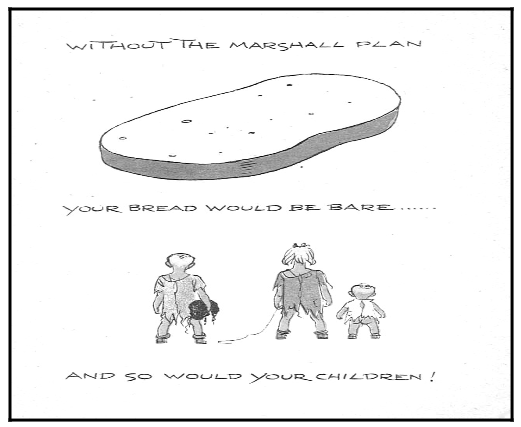
The cartoon below, by Joe Spier, was published in a booklet that was printed by the government of Netherlands in November 1949.
Question
Study Source 1D.
Question
Explain the messages the cartoonist conveys regarding the Marshall Plan.
- The cartoon depicts the Marshall Plan as providing both economic and humanitarian aid to European nations recovering from World War II.
- It conveys that if countries do not accept the Marshall Plan, they will remain poor, illustrated by the absence of buttered bread and the presence of tattered clothing.
- This imagery suggests that the failure to accept the Marshall Plan could lead to economic under-development in certain countries, highlighting the importance of U.S. aid in ensuring recovery and stability.
Question
Comment on why you think the cartoonist used ‘bread’ to symbolize the Marshall Plan.
- The cartoonist used bread to symbolize the Marshall Plan because it represents economic aid in the form of basic necessities that people need to survive and thrive.
- Bread is a universal symbol of sustenance, illustrating that the Marshall Plan would provide the essential financial assistance needed to acquire basic needs.
- By using bread as a symbol, the cartoon emphasizes that the Marshall Plan was crucial for rebuilding economies and ensuring the well-being of citizens in affected countries.
Question
Using the information in the relevant sources and your own knowledge, write a paragraph of about eight lines (about 80 words) explaining how the United States of America and the Soviet Union attempted to create spheres of interest in Europe between 1946 and 1951.
- Between 1946 and 1951, the United States and the Soviet Union actively sought to create their respective spheres of interest in Europe. The U.S. adopted a policy of containment to prevent the spread of communism, which was articulated in the Truman Doctrine and operationalized through the Marshall Plan, offering approximately $13 billion in aid to Western European nations. This financial support aimed to stabilize their economies and encourage capitalist ideologies. In response, the Soviet Union established Cominform to consolidate communist power and counter the influence of the Marshall Plan, ensuring that foreign communist parties would promote Soviet interests. To maintain its sphere, the Soviet Union also invested around $13 billion in Eastern Europe. This ideological conflict resulted in the formation of military alliances, such as NATO and the Warsaw Pact, further solidifying the division of Europe along ideological lines.