History Grade 12 Paper 2 | SECTION A: SOURCE-BASED QUESTIONS
History Grade 12 | Paper 2 | SECTION A: SOURCE-BASED QUESTIONS
| QUESTION : HOW DID THE MASS DEMOCRATIC MOVEMENT (MDM) REACT TO PW BOTHA’S ‘REFORMS’ IN THE 1980s? |
The source below was written by S Dubow, a historian. It explains conditions prevailing (taking place) in South Africa that led to the establishment of the Mass Democratic Movement (MDM) in 1989.
The Mass Democratic Movement (MDM) was a loose alliance of anti-apartheid groups that was formed in 1988 when the apartheid government placed restrictions on the United Democratic Front (UDF) and other activist organisations. The MDM, made up of UDF and African National Congress (ANC) supporters, then emerged as an even wider, more amorphous (unstructured) front to resist apartheid. It also had strong links
with the Congress of South African Trade Unions (COSATU). The fact that the MDM had no permanent structure made it difficult for the government to place a ban on its activities.
In July 1989 COSATU took the lead and called for support from the MDM for a nationwide defiance campaign of protests against segregation in hospitals, beaches and public transport. The result was six weeks of defiant (disobedient) activity, with volunteers deliberately breaking offensive laws and filling prisons.
It was also decided to organise a massive worker stay-away to show contempt (dissatisfaction) for the tricameral elections due to take place on 6 September 1989; more than 3 million workers heeded (obeyed) the call. The campaign was halted in mid-September when the government, with De Klerk taking the lead, agreed to enter into a new era of constitutional negotiations with the ANC.
1.1.1 Why, according to the source, was the MDM formed in 1988?
The Mass Democratic Movement (MDM) was formed in 1988 when the apartheid government placed restrictions on the United Democratic Front (UDF) and other activist organizations.
1.1.2 Identify THREE organizations in the source that were part of the MDM.
The United Democratic Front (UDF) was one of the key organizations that became part of the MDM. The UDF played a significant role in mobilizing various sectors of society against apartheid.
The African National Congress (ANC) was also involved in the MDM. The ANC’s longstanding opposition to apartheid policies aligned with the MDM’s objectives to bring together various forces against the oppressive regime.
Another major organization in the MDM was the Congress of South African Trade Unions (COSATU). As a prominent labor union, COSATU helped the MDM gather support among workers, leveraging worker power to intensify pressure on the apartheid government.
1.1.3 Explain why the MDM operated as an unstructured front in the fight against apartheid.
The MDM operated as an unstructured front to involve a broader range of formations in the fight against apartheid. This approach allowed more organizations and individuals to contribute to the anti-apartheid cause without the constraints of a rigid structure.
An unstructured front made it difficult for the apartheid government to suppress or ban the MDM’s activities. By avoiding a centralized structure, the MDM minimized the risk of large-scale arrests and harassment of its members by the apartheid regime.
The MDM’s unstructured approach also aimed to intensify the struggle against apartheid by creating a united front. This united front strengthened its influence and resilience, amplifying its ability to exert pressure on the apartheid government.
Finally, the MDM’s organizational style helped unify the Congress alliance movement across all sectors of society, including political, labor, and community groups. This unity across diverse groups increased the effectiveness of their campaign to pressurize the apartheid regime into capitulation.
1.1.4 Define the term defiance campaign in your own words.
A defiance campaign is a form of organized protest in which participants deliberately disobey segregation laws as an act of resistance. This type of campaign can include peaceful or violent actions aimed specifically at challenging and undermining discriminatory laws.
In a defiance campaign, individuals and groups engage in civil disobedience, intentionally violating laws that enforce segregation or discrimination. Such actions are taken to draw attention to unjust laws and to push for social and political change.
1.1.5 Why did the MDM decide to organize a worker stay-away against the tricameral elections due to take place on 6 September 1989?
The MDM organized a worker stay-away against the tricameral elections of 6 September 1989 as a rejection of reforms that still excluded Black citizens. The MDM saw the elections as a superficial reform that maintained the fundamental structure of apartheid by continuing to segregate and disenfranchise Black people.
Additionally, the tricameral elections were based on segregation, which meant they did not allow Black South Africans to participate equally. By boycotting the elections, the MDM highlighted its rejection of this exclusionary system.
The worker stay-away was also intended to put economic pressure on the government by disrupting business and productivity. By organizing a stay-away, the MDM encouraged workers to withdraw their labor, creating economic consequences that would pressure the government to reconsider its policies.
| SOURCE 1B The source below has been taken from a newspaper article titled ‘South African Crackdown Defeating Apartheid Defiance Campaign’ published in The Washington Post of 31 August 1989. The nearly month-old campaign of civil disobedience and defiance of restrictions by South African blacks has lost some of its momentum in the face of an intensive nationwide police clampdown and a sharp increase in attacks on anti-apartheid activists by white vigilantes. While leaders of the campaign vowed today to escalate their protests in the last week before next Wednesday’s segregated elections for Parliament, police stepped up bannings of protest meetings and arrests of black nationalists and their liberal white supporters in what they said was an effort to prevent disruption of balloting. Also arrested were Mary Burton, the white president of the Black Sash women’s anti-apartheid group, and Dorothy Boesak, wife of the Rev. Allan Boesak, president of the World Alliance of Reformed Churches. The women had attempted to march to the British Embassy, which is situated on the grounds of South Africa’s Parliament, to present an appeal to British Prime Minister Margaret Thatcher to intercede (mediate) on behalf of black children detained for alleged security offenses. An attempt by blacks to defy bus segregation laws in Pretoria has been mostly frustrated by the arrest of about a dozen protesters before they could board whites-only buses, and plans to launch an ‘all schools for all people’ campaign at which black parents were to have tried to enrol their children in whites-only schools have not materialised. |
1.2.1 State TWO reasons why the nearly month-old campaign of civil disobedience and defiance by South African blacks lost some of its momentum by August 1989.
One reason for the loss of momentum in the civil disobedience campaign was an intensive nationwide police clampdown, which hindered anti-apartheid activities and created a climate of fear.
Another factor contributing to the campaign’s decreased momentum was a sharp increase in attacks on anti-apartheid activists by white vigilantes, which added an extra layer of intimidation and risk for those participating in protests.
1.2.2 Explain why MDM leaders of the defiance campaign decided to escalate their protests a week before the elections for Parliament in September 1989.
MDM leaders escalated their protests to reject the upcoming parliamentary elections, which were based on segregationist laws. This stance emphasized their refusal to accept a political system that continued to exclude Black citizens from full representation.
Additionally, by intensifying protests, the MDM aimed to send a strong message that the tricameral parliament’s elections would not be recognized by the movement or by South African Black communities. Their goal was to discredit the legitimacy of the elections and undermine the apartheid government’s authority.
The campaign escalation was also meant to maintain civil disobedience, keeping the pressure on the government to address the demands of the anti-apartheid movement. By continuing protests, the MDM aimed to destabilize the apartheid regime and demonstrate resilience against government repression.
Finally, escalating the protests served as a tactic to weaken and discredit the apartheid government in the eyes of both South African citizens and the international community. The MDM’s actions underscored the apartheid government’s inability to establish a truly inclusive or representative political system.
1.2.3 Comment on the implication of the march by Mary Burton and Dorothy Boesak for British intervention in South African matters.
The march by Mary Burton and Dorothy Boesak aimed to expose South Africa’s segregationist laws to the international community, especially to Britain. By attempting to reach the British Embassy, they sought to draw attention to the apartheid system and encourage foreign support for anti-apartheid efforts.
Their march demonstrated that the MDM was prepared to use international channels to express their opposition, signaling to the South African government that the movement would pursue all possible avenues to reject apartheid reforms. This highlighted the MDM’s commitment to appealing for external pressure on the apartheid regime.
Additionally, the march aimed to garner support from the British government, given that South Africa was a member of the British Commonwealth. Burton and Boesak’s appeal to British Prime Minister Margaret Thatcher showed a strategic effort to involve Britain, using Commonwealth ties to advocate for detained Black children and further internationalize their cause.
1.2.4 Give TWO protest actions, named in the source, that could not materialize because of arrests or other restrictions on MDM activists.
One protest action that was thwarted due to arrests and restrictions was the attempt by Black protesters to defy bus segregation laws. Police intervention prevented many from boarding whites-only buses, effectively frustrating this act of civil disobedience.
Another planned protest action that did not materialize was the “all schools for all people” campaign. This initiative, which aimed to have Black parents enroll their children in whites-only schools, could not proceed due to restrictions and the arrests of MDM activists.
| SOURCE 1C The source below has been taken from a newspaper article published in The Washington Post on 14 September 1989. It outlines the events that unfolded during the peace march organised by the Mass Democratic Movement (MDM) in Cape Town on 13 September 1989. More than 20 000 anti-government protesters of all races filled Cape Town’s main thoroughfare today in a ‘march for peace’ that civil rights leaders said demonstrated the needlessness (uselessness) of emergency decrees (laws) normally prohibiting such expressions of political dissent (conflict). The demonstration, which took place without incident, was one of the largest ever held in South Africa and the only one in recent years to receive an official government waiver (surrender) of more than a dozen emergency regulations under which it could have been banned in advance or forcibly broken up. The Rev. Allan Boesak, who with Anglican Archbishop Desmond Tutu led the mile-long procession, vowed to cheering supporters at the City Hall to continue the anti-apartheid movement’s six-week campaign of defiance ‘as long as our people are not allowed to vote in a government of our choice’. Today, a human tide of black, white and ‘Colored’, or mixed-race, protesters moved down the city’s broad Adderley Street, singing ‘We Shall Overcome’ and other freedom songs in an outpouring (burst) reminiscent (famous) of the US Civil Rights Movement in the 1960s. Marchers carried the banner of the outlawed African National Congress and other emblems of revolution and openly called for the overthrow of the government and scoffed (mocked) at the myriad (many) laws against political dissent (disagreement) that, at any other time in the past three years, would almost certainly have invited harsh intervention by the police. … Tutu, wearing lavender (purple) robes and beaming at the crowd, said, ‘Today is a day on which we, the people, have scored a great victory for justice and peace.’ |
1.3.1 Provide evidence from Source 1C regarding the nature and scale of the peace march organized by the MDM in Cape Town.
One piece of evidence showing the scale of the peace march is that “more than 20,000 anti-government protesters of all races filled Cape Town’s main thoroughfare.” This large turnout demonstrated widespread support across racial groups.
Another detail highlighting the march’s significance was that civil rights leaders noted it “demonstrated the needlessness of emergency decrees,” emphasizing that the protest occurred peacefully without police intervention, despite the presence of emergency laws.
The march was also noted as “one of the largest ever held in South Africa” and “the only one receiving a government waiver of emergency regulations,” making it a unique event in the anti-apartheid struggle.
Finally, Archbishop Desmond Tutu remarked, “Today is a day on which we, the people, have scored a great victory for justice and peace,” showing the symbolic importance of the peaceful protest for South Africa’s liberation movement.
1.3.2 Explain why the government, led by F.W. de Klerk, allowed the MDM’s peace march in Cape Town to proceed without enforcing emergency laws.
One reason F.W. de Klerk permitted the march was to signal his intention to put South Africa on a path toward democracy. As the new leader of the National Party, de Klerk aimed to demonstrate his willingness to allow greater freedoms, reflecting a shift in approach to governance.
De Klerk’s decision also showed a more liberal stance toward political expression, indicating a possible reformist agenda. By allowing the march, he presented himself as open to change, contrasting with the apartheid regime’s traditionally strict approach to protests.
Another reason for the waiver was to prevent negative publicity and enhance South Africa’s international image. By allowing the march to proceed without incident, de Klerk aimed to present South Africa as more tolerant, which could attract positive global attention and reduce foreign criticisms of apartheid policies.
Finally, the march demonstrated that the liberation struggle had intensified to the point where the apartheid government was now more willing to negotiate. The scale of the protest, along with the peaceful but powerful message of defiance, underscored the movement’s influence and the pressure it exerted on the government.
1.3.3 Define the term “emergency decrees” as used in the context of Source 1C.
Emergency decrees were temporary laws imposed by the apartheid regime to control political activities organized by the liberation movement against its discriminatory policies. These laws allowed the government to limit public gatherings, protests, and expressions of dissent to maintain control over political opposition.
Additionally, these special measures were applied to suppress any opposition and protest activities that challenged the apartheid government. The decrees enabled the authorities to intervene in anti-apartheid activities with severe legal powers, such as bans, arrests, and detentions.
Moreover, emergency decrees served as tools to prohibit expressions rejecting the apartheid system. These laws restricted freedom of speech and assembly, aiming to prevent the spread of anti-apartheid sentiment and activism.
1.3.4 Provide evidence from Source 1C that highlights the unity among protesters during the peace march.
The source describes a “human tide of black, white, and ‘Colored’, or mixed-race, protesters,” demonstrating the multi-racial unity of the march. This diverse participation underscored the solidarity against apartheid across different racial communities in South Africa.
The marchers were also “singing ‘We Shall Overcome’ and other freedom songs in an outpouring reminiscent of the US Civil Rights Movement in the 1960s.” This reference highlights the spirit of unity and shared purpose, symbolizing a collective resistance against oppression similar to that seen in the American civil rights struggle.
SOURCE 1D
The photograph below (photographer unknown) was taken on 13 September 1989. It depicts part of the crowd which attended the peace march that was organised by the Mass Democratic Movement (MDM), with Allan Boesak, one of its leaders visible.
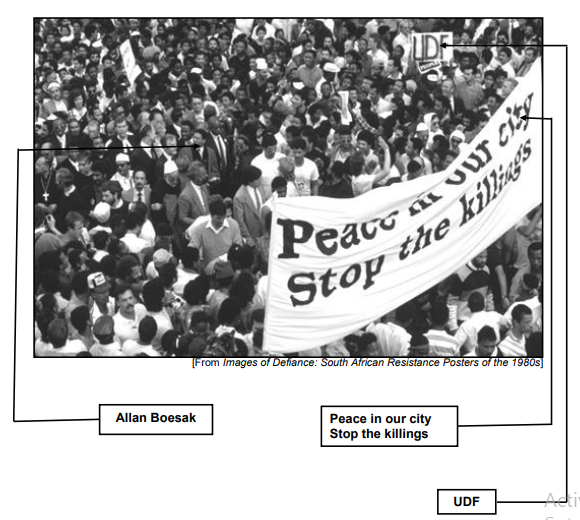
1.4.1 Why do you think this photograph was taken on 13 September 1989?
The photograph was likely taken to document a unique event, as it was the first march of its kind allowed by the apartheid regime. This made the march historically significant and worthy of recording.
Additionally, the photograph captures the large, multiracial crowd in attendance, showcasing unity and solidarity across racial lines. This visual evidence highlights the scale of support for the MDM’s cause.
The image also emphasizes the role of Allan Boesak, a prominent MDM leader, illustrating the involvement of key figures in the anti-apartheid movement. His presence underscores the leadership and organization behind the protest.
The photograph could have been intended to gain international support by highlighting the peaceful nature of the protest and the strength of public demand for change, appealing to a global audience to show solidarity with South Africa’s liberation struggle.
Finally, the photograph visually captures the public’s demands, as represented by the large, peaceful gathering. This image conveyed the people’s calls for justice and democracy under the apartheid government.
1.4.2 Explain the usefulness of this source to a historian studying the 13 September 1989 peace march.
The source is useful because it is a photograph, offering first-hand, visual evidence of the event, which allows historians to observe directly rather than interpret from text alone. It serves as a primary source of information about the march.
Taken on the actual day of the peace march, 13 September 1989, the photograph provides an authentic snapshot of the event, adding credibility and immediacy to the historical record of that day.
The photograph shows the multiracial nature of the marchers, confirming details from Source 1C about unity and solidarity across racial lines. This evidence can help historians understand the social dynamics and inclusivity of the movement.
Additionally, the image captures Allan Boesak leading the march, which reflects the involvement of high-profile leaders and lends insight into the march’s organization and leadership.
Finally, as a visual record of the peace march, the photograph is a valuable tool for historians studying the impact and public sentiment of the time. It provides a tangible representation of the anti-apartheid movement’s strength and reach.
1.5 Refer to Sources 1C and 1D. Explain how the evidence in Source 1D supports the information in Source 1C regarding the events that unfolded during the peace march organised by the MDM on 13 September 1989.
The peace march organized by the MDM on 13 September 1989 in Cape Town is described in Source 1C, and the photographic evidence in Source 1D visually confirms these details, demonstrating the impact and unity of the event. Source 1C mentions the participation of over 20,000 anti-apartheid protesters, making it one of South Africa’s largest marches; Source 1D visually supports this by showing the large crowd gathered in solidarity.
The multiracial composition of the protestors, which Source 1C highlights, is also depicted in Source 1D, showing people from various racial backgrounds marching together. This unity among different racial groups underscored the MDM’s inclusive approach to the struggle against apartheid.
Both sources also depict the peaceful nature of the march, with Source 1C noting that the march proceeded without incident or police intervention, while Source 1D shows protestors peacefully marching without any visible police interference, reflecting the nonviolent approach of the movement.
Additionally, Source 1C mentions that prominent MDM leaders like Desmond Tutu and Allan Boesak led the march. In Source 1D, Allan Boesak’s presence is visible, reinforcing the importance of MDM leadership in organizing and supporting the march.
Finally, Source 1C refers to banners and placards carried by the marchers, expressing anti-apartheid sentiments. This detail is corroborated by Source 1D, where banners and posters held by the crowd can be seen, symbolizing the protestors’ demand for justice and equality. Together, both sources provide a comprehensive view of the event’s scale, unity, and peaceful conduct, underscoring the effectiveness of the MDM’s organizing efforts.
1.6 Using the information in the relevant sources and your own knowledge, write a paragraph of about EIGHT lines (about 80 words) explaining how the MDM reacted to PW Botha’s ‘reforms’ in the 1980s
The MDM, formed in 1989 after the UDF’s ban, was a coalition of anti-apartheid groups united to oppose Botha’s reforms. It organized civil disobedience, including defiance campaigns against segregation laws and the 1989 tricameral elections. The MDM’s protests faced heavy police repression, but it escalated actions, such as the peaceful 13 September march. The MDM also challenged bus segregation, organized stay-aways, consumer boycotts, and the “all schools for all” campaign. Its non-violent approach united multiracial groups, achieved success despite government repression, and attracted international attention.
QUESTION 2: WAS THE TRUTH AND RECONCILIATION COMMISSION (TRC) SUCCESSFUL IN ATTAINING ITS AIMS WITH ARCHBISHOP DESMOND TUTU AS ITS CHAIRPERSON?
| SOURCE 2A The source below has been taken from an online newspaper article titled ‘World Leaders Mourn Archbishop Desmond Tutu in Acknowledgement of Services Rendered to Imperialism: Sanitising the Crimes of Apartheid’, by Professor Jean Shaoul on 5 January 2022. It explains Tutu’s contribution as chairperson of the Truth and Reconciliation Commission (TRC). Nelson Mandela, the first democratic South African president, chose Archbishop Tutu to chair the commission. Set up in 1996, its purpose was to head off (prevent) popular demands for the trials of those responsible for the deaths and torture of tens of thousands of black workers and youth under apartheid. Tutu called for reconciliation with the perpetrators of truly horrendous (horrific) crimes, with victims and perpetrators describing the cold-blooded details of torture and assassination (political murders). The Commission catalogued (recorded) atrocities (political killings) including the Sharpeville Massacre in 1960, the killings in Soweto in 1976 and in Langa in 1985, and the death squads in the notorious (well-known) Vlakplaas camp. It concluded that the ruling National Party government and its security forces were responsible for the majority of human rights abuses, backed by big business and supported by the judiciary (judges), the media and the church. The introduction to the TRC’s five-volume report, published in 1998, confirmed that the increasingly brutal imposition (forcing) of apartheid was motivated primarily by fear of social revolution, dressed up as the ‘communist threat’ in Africa; that the decision to end apartheid and bring the ANC to power was aimed at staving (preventing) off mass revolution by South Africa’s workers and youth; and that the path taken by the ANC was designed to prevent such a revolution. Tutu said, ‘Had the miracle of the negotiated settlement not occurred, we would have been overwhelmed by the bloodbath that virtually everyone predicted as the inevitable ending for South Africa.’ From ‘World Leaders Mourn Archbishop Desmond Tutu in Acknowledgement of Services Rendered to imperialism: Sanitising the Crimes of Apartheid’ by J Shaoul] |
2.1.1: What, according to the source, was the purpose of the TRC when it was set up in 1996?
The purpose of the TRC, as stated in the source, was “to head off popular demands for the trials of those responsible for the deaths and torture of tens of thousands of black workers and youth under apartheid” . This shows that the TRC was established to prevent the demand for trials of those who committed human rights abuses under apartheid, in order to avoid further conflict and unrest in South Africa.
2.1.2: Identify THREE areas recorded by the Commission where horrendous atrocities (horrific killings) were committed against political activists.
The Commission recorded the following areas where horrific killings occurred:
- Sharpeville
- Soweto
- Langa
- Vlakplaas camp
These sites were key locations where anti-apartheid activists faced violent repression and where significant atrocities occurred during the apartheid era.
2.1.3: Comment on the meaning of the statement, ‘the decision to end apartheid and bring the ANC to power was aimed at staving off mass revolution by South Africa’s workers and youth.’
The statement suggests that the apartheid government’s decision to end apartheid and bring the ANC to power was a strategic move aimed at preventing mass demonstrations and labour uprisings, which could have led to the collapse of apartheid. It was meant to stop potential revolutions or civil war that could have erupted from the growing discontent among workers and youth who were mobilizing against apartheid policies.
2.1.4: Explain why you think the TRC played an important contributory role in avoiding a bloodbath in South Africa.
The TRC was established to address the atrocities committed during the apartheid era, serving as a platform for truth-telling and reconciliation. It was used as an instrument to heal and build a united South Africa. By emphasizing restorative justice, including amnesty and reparations, the TRC helped prevent revenge and bloodshed. Some family members of victims were able to find closure, and South Africans were given the opportunity to confront past atrocities. This reconciliation process played a key role in preventing a bloodbath and facilitating the peaceful transition to a democratic South Africa.
4o mini
SOURCE 2B
The cartoon below drawn by J Shapiro, ‘Zapiro’, depicts the handover of the Truth and Reconciliation Commission final report by Archbishop Desmond Tutu to Thabo Mbeki in Cape Town in 1998.
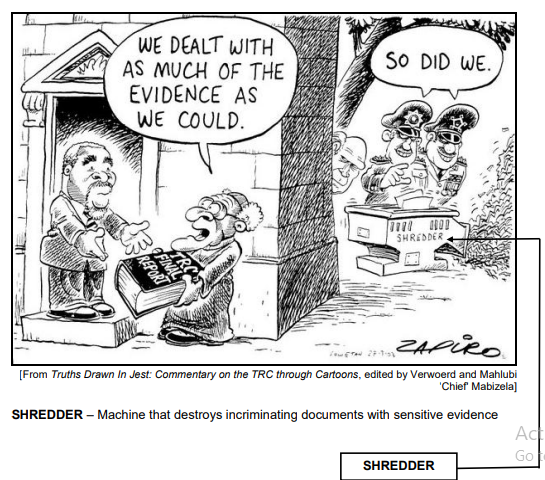
2.2.1: What messages are conveyed by this cartoon regarding the evidence in the final TRC report?
The cartoon conveys that the Truth and Reconciliation Commission (TRC) faced challenges in fully documenting all human rights violations due to the destruction of evidence. Desmond Tutu is shown delivering the final TRC report to Thabo Mbeki, but the presence of a shredder symbolizing the destruction of incriminating documents highlights how much evidence was lost. The TRC was unable to cover all cases because apartheid security forces had destroyed vital records of crimes. The cartoon also suggests that the TRC’s aims were not fully achieved, as Tutu acknowledges, “we dealt with much of the evidence as we could.” Additionally, FW de Klerk is depicted as peeping, suggesting that he may be hiding or avoiding responsibility for past actions.
2.2.2: Explain the implication of the phrase ‘SO DID WE’ by the security forces regarding their contribution to the TRC report.
The phrase “SO DID WE” in the cartoon implies that the security forces, represented by the shredder, did not fully disclose the truth about their involvement in human rights violations. The security forces are depicted as saying they too contributed to the TRC report, but in reality, they sabotaged it by shredding essential government records and documents. This action ensured that critical evidence of their actions, and of the apartheid government’s crimes, could not be included in the final TRC report, thus weakening the integrity of the commission’s findings. This suggests that the security forces attempted to cover up their roles in the atrocities committed during apartheid.
| SOURCE 2C The extract below has been taken from a briefing paper titled, ‘Truth and Justice: Unfinished Business in South Africa’, by Amnesty International/Human Rights Watch. It highlighted how the recommendations of the TRC report were to be taken further by the judiciary (judges) and the post-1994 government. Even before the Truth and Reconciliation Commission (TRC) chairperson delivered its 1998 final report, there were a number of prosecutions of perpetrators responsible for human rights abuses in the pre-May 1994 period. These trial proceedings constituted a critical part of the context in which the TRC was working, and continue to have important consequences today. In particular, the failure of several trials has meant that some sectors of the former security forces have virtually escaped accountability for serious human rights abuses. The TRC in its 1998 report made recommendations that information it collected in the course of its investigations should be used as the basis for the further investigation and prosecution of individuals responsible for gross human rights violations that had not been granted amnesty. In particular, the TRC urged the justice system to ‘pay rigorous attention to the prosecution of members of the South African Police Service (SAPS) who are found to have assaulted, tortured and/or killed persons in their care’. The persistence of incidents of torture, assault with intent to inflict grievous (serious) bodily harm and execution-style killings of arrested suspects in police investigations highlight the urgency (speed) of this recommendation by the TRC. Since 1998 progress in acting on this recommendation has been slow, although the government has established a unit in the office of the National Director for Public Prosecutions (NDPP) to pursue these cases. This ‘special national projects’ unit also deals with organised crime cases. Its small staff, under an experienced advocate and prosecutor, is still involved in identifying and preparing cases for possible prosecution. Limited resources and obstacles to recovering evidence will restrict its ability to prosecute many cases. [From ‘Truth and Justice: Unfinished Business in South Africa’, 2003, by Amnesty International/Human Rights Watch |
2.3.1: What, according to the source, did the failure of several pre-1998 trials mean for some former security forces?
The failure of several pre-1998 trials meant that some sectors of the former security forces “virtually escaped accountability for serious human rights abuses” . This indicates that, despite efforts to hold perpetrators accountable, some individuals responsible for human rights violations were not brought to justice.
2.3.2: Define the concept perpetrators in the context of the TRC.
In the context of the TRC, “perpetrators” refer to individuals or groups, especially members of the security forces, who committed gross human rights violations between 1960 and 1994 in South Africa. These violations included acts such as torture, assault, and murder, particularly during the apartheid era.
2.3.3: Explain why the TRC cannot be blamed for the failure of the National Director for Public Prosecutions (NDPP) to prosecute.
The TRC cannot be blamed for the failure of the NDPP to prosecute because the TRC’s mandate was to make recommendations, not to enforce them. The TRC had no legal power to compel the NDPP to act. The responsibility for prosecution rested with the post-1994 government, which, despite the TRC’s recommendations, failed to ensure accountability for perpetrators. Additionally, the TRC focused on restorative justice rather than punitive measures, meaning it did not have the authority to prosecute criminals directly.
2.3.4: Identify THREE reasons in the source why the NDPP’s progress in acting on the recommendation by the TRC was slowed down.
- The NDPP’s unit also had to handle organized crime cases alongside the TRC-related human rights violations.
- The unit faced “limited resources,” which hindered its ability to pursue cases efficiently.
- “Obstacles to recovering evidence” made it difficult for the NDPP to build strong cases for prosecution, further slowing progress.
2.3.5: Comment on the limitations of this source for a researcher studying the success of the TRC.
This source has several limitations for a researcher studying the success of the TRC.
First, the title “Truth and Justice: Unfinished Business” suggests a critical perspective on the TRC’s effectiveness, which may present a one-sided view.
Furthermore, the source was published five years after the TRC’s 1998 report, potentially reflecting only a partial picture of its long-term impact.
Additionally, Amnesty International/Human Rights Watch might have their own biases, given their advocacy role, which could color their interpretation of the TRC’s success or failure.
Lastly, the TRC was limited in scope, as it could only make recommendations and did not have the power to enforce them, a factor not fully captured in this source.
2.4: Refer to Sources 2B and 2C. Explain how the information in Source 2B supports the evidence in Source 2C regarding the weaknesses of the TRC report.
The Truth and Reconciliation Commission (TRC) report, finalized in 1998, aimed to address human rights violations in South Africa, but it encountered significant obstacles, as noted in both Sources 2B and 2C. In Source 2B, Archbishop Desmond Tutu, chairperson of the TRC, acknowledged that the report was not entirely conclusive, indicating that the commission addressed “as much of the evidence as we could.” This statement supports Source 2C’s characterization of the TRC’s work as “unfinished business,” suggesting limitations in the commission’s investigative reach and its ability to bring closure.
Source 2B also illustrates the issue of evidence destruction by showing former South African President F.W. de Klerk and members of the security forces using a shredding machine, which hindered the TRC’s capacity to gather comprehensive information on human rights abuses. This detail aligns with Source 2C, which mentions the failure of several trials due to insufficient evidence, allowing many former security forces to escape accountability. Together, these sources reveal that the TRC’s effectiveness was curtailed not only by its limited mandate but also by external factors, such as destroyed records, that obstructed justice for numerous victims.
These challenges underscore the limitations of the TRC report in fulfilling its mission of reconciliation and justice, revealing how the commission, despite its efforts, was unable to achieve full accountability for apartheid-era abuses.
4o
| SOURCE 2D The source below is based on a public debate on the legacy of the Truth and Reconciliation Commission. It was held in Cape Town and hosted by Newzroom Afrika, a South African television news channel. Anita Dywaba, a junior multimedia journalist, reviewed the debate on Independent Online (IOL) News on 27 December 2021. Since the announcement of Archbishop Emeritus Desmond Tutu’s passing, social media has been abuzz (busy) with many praising the fallen hero for his activism work against the engineers of the apartheid regime, the National Party. As most of the world reminisce (recall) their personal encounters with the late Archbishop Emeritus Desmond Tutu, some have expressed despondency (hopelessness) with the news of his passing. The sadness seemingly stems from the perceived failure of the Truth and Reconciliation Commission (TRC) that Tutu chaired. In response to this criticism, former President of South Africa, Thabo Mbeki, said that the Archbishop should not bear the responsibility of the shortcomings of the Truth and Reconciliation Commission. ‘No, the Archbishop cannot be blamed for whatever the shortcomings were. There might have been shortcomings in the design of the process, in which case we who designed it would then have to take responsibility for whatever blame,’ said Mbeki. Mbeki said the Archbishop and others who were part of the TRC did the best they could in the circumstances to help build the new South Africa. ‘I do not think that the TRC fell short of what it was designed to achieve; there might have been wrong expectations out of it. The process of reconciliation is a remaining challenge for us, but that process of reconciliation could not be achieved merely through the TRC process,’ Mbeki said. ‘The eradication (ending) of the legacy of apartheid and colonialism was not the task of the TRC; that was the task of the government post-1994,’ he said. [From Independent Online (IOL) News, 27 December 2021] |
2.5.1: How, according to the source, did social media describe Archbishop Tutu on hearing of his passing (death)?
On social media, many praised Archbishop Tutu as a “fallen hero” for his activism against the National Party’s apartheid regime, acknowledging his legacy in the fight for justice and human rights.
2.5.2: Explain what is implied by Mbeki’s statement, ‘there might have been shortcomings in the design of the process,’ with reference to the TRC.
Mbeki’s statement implies that the limitations of the TRC were due to its original design and scope, which restricted it from fully addressing justice and accountability. He suggests that the responsibility for these shortcomings lies with those who structured the TRC, not with Tutu, who effectively fulfilled his role as its chairperson.
2.5.3: Using your own words define the concept reconciliation.
Reconciliation is a process that fosters peace and understanding between former adversaries, allowing victims to hear explanations for injustices and forgive perpetrators. It is also a way for perpetrators to accept responsibility and work to heal the harm done, without necessarily facing punishment.
2.6: Using the information in the relevant sources and your own knowledge, write a paragraph of about EIGHT lines (about 80 words) explaining whether the Truth and Reconciliation Commission (TRC) was successful in attaining its aims with Archbishop Desmond Tutu as its chairperson.
The Truth and Reconciliation Commission (TRC), chaired by Archbishop Desmond Tutu, achieved some success in promoting peace and uncovering apartheid atrocities. Through the testimonies and confessions of perpetrators, the TRC documented severe human rights abuses, allowing some families to gain closure by locating the remains of missing loved ones. The process, though limited, avoided large-scale violence and led to a measure of reconciliation between communities (Source 2A). While some critics argue that justice was incomplete, others, like former President Thabo Mbeki, maintain that Tutu effectively fulfilled the TRC’s mandate (Source 2D).