Life Sciences Grade 11 Exam Revision: Past Paper Questions & Answers 1
Life Sciences Grade 11
Various options are provided as possible answers to the following questions. Choose the correct answer
Question
Which chemical is a product of photosynthesis that moves out of a green leaf through its stomata?
A. Carbon dioxide
B. Glucose
C. Oxygen
D. Water
The correct answer is C. Oxygen
Oxygen is a by-product of photosynthesis and is released into the atmosphere through the stomata. While carbon dioxide enters the leaf and glucose remains inside for storage or energy, oxygen exits as waste gas through these tiny pores.
Question
The products of protein digestion are …
A. Amino acids
B. Fatty acids
C. Glycerol
D. Simple sugars
The correct answer is A. Amino acids
Proteins are broken down by enzymes into amino acids during digestion. These small molecules are then absorbed into the bloodstream and used by the body for growth and repair.
Question
Where in a cell does cellular respiration take place?
A. Nucleus
B. Mitochondria
C. Chloroplasts
D. All cell membranes
The correct answer is B. Mitochondria
Mitochondria are often referred to as the “powerhouses” of the cell because they are the main site where energy (ATP) is produced during cellular respiration.
Question
The process that occurs in the capsules of some plants to form spores is:
A. Mitosis
B. Binary fission
C. Meiosis
D. Fertilisation
The correct answer is C. Meiosis
Meiosis is a type of cell division that reduces the chromosome number by half, producing spores in plants which can grow into new gametophytes in the plant life cycle.
Question
A closed blood system is found in:
A. Annelida
B. Insecta
C. Cnidaria
D. Porifera
The correct answer is A. Annelida
Annelids, such as earthworms, have a closed circulatory system where blood is contained within vessels, unlike organisms like insects and cnidarians that have open or no circulatory systems.
Question
Which animal activity is NOT beneficial to farmers?
A. Dogs herding sheep on a Karoo farm
B. Soil organisms preying on crop pests and maintaining low numbers
C. Swallows preying on insect larvae that destroy crop plants
D. Mice feeding on wheat in storerooms
The correct answer is D. Mice feeding on wheat in storerooms
Mice are pests in agricultural settings because they consume stored crops and can cause contamination and economic loss, making their activity harmful to farmers.
Study the diagram below of an animal’s skull and answer the following Questions

Question
The above skull is that of a …
A. Omnivore because of large canines and flat molars.
B. Carnivore because of reduced molar number.
C. Omnivore because canines, incisors and molars are present.
D. Carnivore because of large canines and sharp molars.
The correct answer is D. Carnivore because of large canines and sharp molars
Carnivores typically have large, pointed canines for piercing flesh and sharp molars for cutting meat, which are key features for a meat-based diet.
Question
A function of the incisors of such an animal would be to:
A. Grind and crush food
B. Catch and hold onto prey
C. Bite and cut food
D. Kill prey and tear-off flesh
The correct answer is C. Bite and cut food
Incisors are the flat, sharp-edged teeth at the front of the mouth that help in biting and cutting food, especially useful for the initial breakdown of meat or plant material.
Question
Which ONE of the options listed below CORRECTLY summarises the waste product for each of the excretory organs?
| Option | LUNGS | SKIN | LIVER | KIDNEY |
|---|---|---|---|---|
| A | CO₂ | Water | Urine | Bile |
| B | CO₂ | Water | Urea | Urine |
| C | Water vapour | Bile | Water | Salts |
| D | Urea | Water | Bile | CO₂ |
The correct answer is B. CO₂, Water, Urea, Urine
Each organ removes a specific waste: lungs remove carbon dioxide, skin excretes water and salts, the liver breaks down proteins into urea, and the kidneys excrete urea through urine.
Question
It is recommended that athletes train at a higher altitude for at least two weeks before a major event to increase the number of red blood cells in their body. The number of red blood cells increase to …
A. Increase oxygen absorption because of the low oxygen levels in the atmosphere.
B. Allow the body time to remove excess carbon dioxide due to higher levels of carbon dioxide in the atmosphere.
C. Increase the amount of carbon dioxide exhaled due to high oxygen levels in the atmosphere.
D. Allow the body to absorb more oxygen due to high levels of oxygen in the atmosphere.
The correct answer is A. Increase oxygen absorption because of the low oxygen levels in the atmosphere
Training at high altitudes triggers the body to produce more red blood cells to improve oxygen transport, as the oxygen concentration in the air is lower at higher elevations.
Question
The reason for boiling the leaf in alcohol during a starch test is to …
A. Remove chlorophyll.
B. Show if starch is present.
C. Break cell walls making cells more permeable.
D. Kill the plant cells.
The correct answer is A. Remove chlorophyll
Boiling the leaf in alcohol decolorizes it by removing the green chlorophyll pigment, which allows the iodine solution to clearly show whether starch is present.
Question
If the blood pH decreases, the kidneys will …
A. Increase the absorption of urea into the blood.
B. Decrease the secretion of hydrogen ions into the tubules.
C. Increase the re-absorption of bicarbonate ions into the blood.
D. Decrease the absorption of sodium ions into the blood.
The correct answer is C. Increase the re-absorption of bicarbonate ions into the blood
When blood becomes more acidic (lower pH), the kidneys respond by reabsorbing more bicarbonate ions to neutralize the excess hydrogen ions and restore pH balance.
Question
Study the list below and answer the question.
(i) Water
(ii) CO₂
(iii) Hydrogen (H⁺) ions
(iv) Radiant energy
Which of the above listed reactants are required for photosynthesis?
A. (i); (ii) and (iv)
B. (i); (iii) and (iv)
C. (iv) only
D. (i) and (iv)
The correct answer is A. (i); (ii) and (iv)
Photosynthesis requires water and carbon dioxide as raw materials, and radiant energy from sunlight to drive the process, making these three components essential.
Question
A plant’s stomata close when temperatures exceed 30 ºC.
What is the most likely factor to limit the photosynthetic rate after this happens?
A. Oxygen concentration
B. Light intensity
C. Temperature
D. Carbon dioxide concentration
The correct answer is D. Carbon dioxide concentration
When stomata close to prevent water loss, the intake of carbon dioxide is also reduced, thereby limiting the photosynthetic rate despite the availability of light and heat.
Question
In the diagram below, identify the process occurring at X and Y between bodily tissue cells and a capillary.
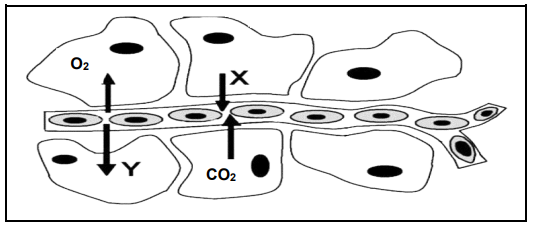
A. Gaseous exchange, active process
B. Cellular respiration, passive process
C. Gaseous exchange, passive process
D. Cellular respiration, active process
The correct answer is C. Gaseous exchange, passive process
Gaseous exchange between tissues and capillaries occurs through diffusion, which is a passive process requiring no energy, allowing oxygen and carbon dioxide to move along concentration gradients.
Give the correct biological term for each of the following descriptions.
Question
Organelle in plant cells that contain chlorophyll
The correct term is Chloroplast
Chloroplasts are green organelles in plant cells that contain chlorophyll, which is responsible for absorbing sunlight and converting it into chemical energy during photosynthesis.
Question
Breathing muscle responsible for raising the rib cage during inhalation
The correct term is Intercostal muscle
Intercostal muscles are found between the ribs and play a key role in breathing by contracting to lift the rib cage upward and outward during inhalation.
Question
Tubule responsible for transporting urine from the kidney to the bladder
The correct term is Ureter
The ureter is a muscular tube that transports urine from the kidneys to the urinary bladder, where it is temporarily stored before being excreted.
Question
Structures in the lung where gaseous exchange occurs
The correct term is Alveoli
Alveoli are microscopic air sacs within the lungs where oxygen from the air passes into the blood and carbon dioxide is removed from the blood and exhaled.
Question
The main photosynthetic tissue of the leaf
The correct term is Palisade mesophyll / chlorenchyma / palisade parenchyma
This layer of cells, found beneath the upper epidermis of the leaf, is rich in chloroplasts and carries out most of the photosynthesis due to its optimal position for light absorption.
Question
The breakdown of a water molecule into hydrogen and oxygen atoms during photosynthesis
The correct term is Photolysis
Photolysis is a light-dependent reaction in photosynthesis where water molecules are split into hydrogen ions, electrons, and oxygen using energy from sunlight.
Question
Protective double membrane enclosing the lungs
The correct term is Pleural membrane / pleura
The pleural membrane, or pleura, is a double-layered membrane that surrounds each lung and produces fluid to reduce friction during breathing movements.
Question
Gas required for aerobic respiration
The correct term is Oxygen
Oxygen is vital for aerobic respiration as it enables cells to break down glucose efficiently, releasing energy stored in the form of ATP.
Question
Patches of cells in the pancreas that secrete insulin and glucagon
The correct term is Islets of Langerhans
The Islets of Langerhans are groups of specialized cells in the pancreas that regulate blood sugar levels by producing the hormones insulin and glucagon.