Life Sciences Grade 11 Exam Revision: Past Paper Questions & Answers 4
Life Sciences Grade 11
The diagram below shows a cell organelle responsible for cellular respiration. Study it and answer the following questions.
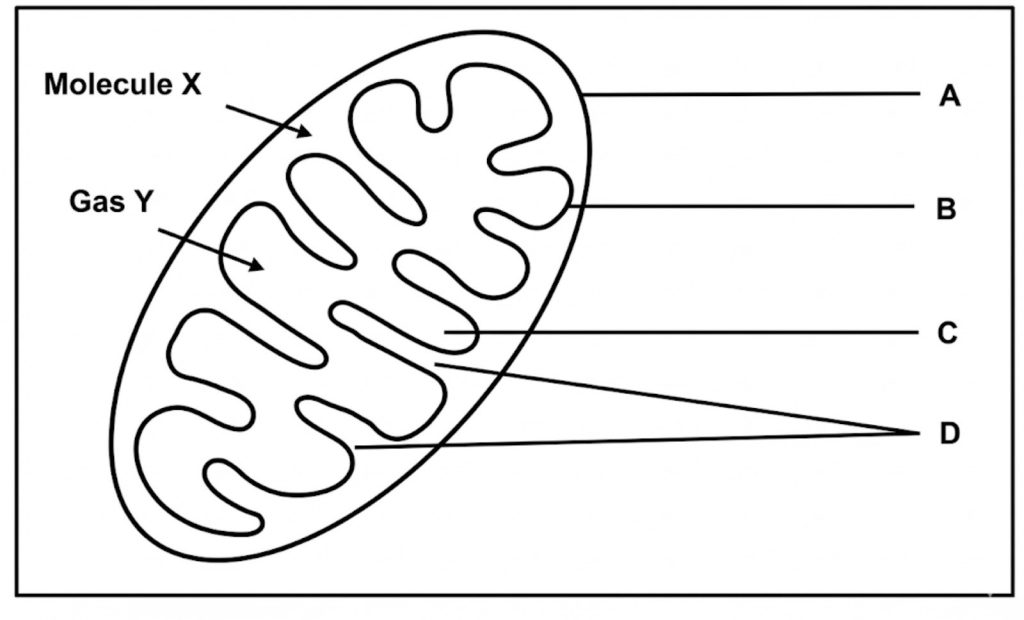
QUESTION: Identify Part A of the organelle.
Correct answer is: Smooth outer membrane.
This outer layer surrounds the entire mitochondrion, protecting its internal structures. It also acts as a selective barrier, allowing only certain molecules to pass through so that the organelle can function efficiently during energy production.
QUESTION: Identify Gas Y.
Correct answer is: Oxygen.
Oxygen is essential for the electron transport chain, the final stage of aerobic respiration. It serves as the final electron acceptor, enabling the cell to produce large amounts of ATP needed for active processes.
QUESTION: Identify Molecule X.
Correct answer is: Pyruvic acid.
This molecule forms at the end of glycolysis and moves into the mitochondrion. Once inside, it is converted and processed to release more energy, making it a key link between glycolysis and the Krebs cycle.
QUESTION: Give the letter and name of the part that contains enzymes responsible for production of energy carriers.
Correct answer is: C – Matrix.
The matrix is filled with enzymes that drive the Krebs cycle. This cycle produces important molecules such as NADH and FADH₂, which carry high-energy hydrogen atoms to the next stage of respiration.
QUESTION: Give the letter and name of the part that is folded to increase the surface area for attachment of enzymes.
Correct answer is: D – Cristae.
These inward folds increase the surface area of the inner membrane. More surface area means more space for electron transport chain enzymes, allowing the mitochondrion to generate ATP more efficiently.
QUESTION: Name the phase of aerobic respiration that occurs outside the organelle shown above.
Correct answer is: Glycolysis.
This process occurs in the cytoplasm before the mitochondrion becomes involved. Here, glucose is broken down into pyruvic acid, releasing small amounts of energy that prepare the molecule for further breakdown in the mitochondrion.
QUESTION: Name the phase that releases energized hydrogen atoms and carbon dioxide.
Correct answer is: Krebs cycle (citric acid cycle).
In this cycle, pyruvic acid is completely broken down. Carbon dioxide is given off as waste, and high-energy hydrogen atoms are captured by carrier molecules to be used in the electron transport chain.
QUESTION: Give two end products of aerobic respiration in muscle cells.
Correct answer is: Carbon dioxide and water.
These substances are formed after glucose is fully oxidized in the presence of oxygen. They are released as waste products while the cell gains ATP required for muscle contraction and other activities.
Life Sciences Grade 11
The diagrams below represent the body plans of different phyla.
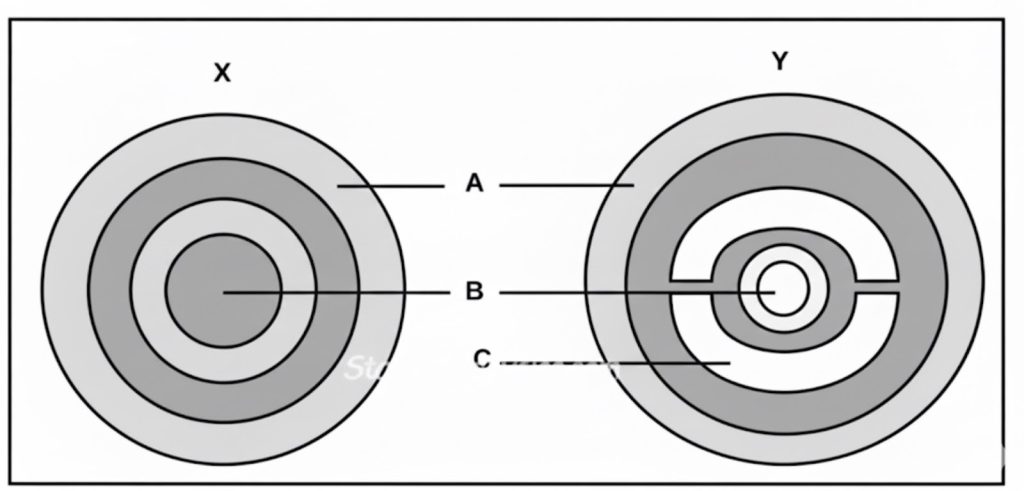
Question: Identify part A
Correct answer is: Ectoderm
This is the outermost tissue layer that forms structures such as skin and nerve tissues in animals.
Question: Identify part B
Correct answer is: Gut
This is the internal digestive cavity where food is broken down and absorbed.
Question: Identify part C
Correct answer is: Coelom
This is a fluid-filled body cavity lined by mesoderm, allowing organs to be protected and suspended.
Question: Name the phyla represented by body plan Y
Correct answer is: Annelida, Arthropoda, Chordata
These phyla are triploblastic, coelomate organisms with a complete body cavity (coelom) that supports complex organ systems.
Question: Give the letter of the diagram that represents a diploblastic animal
Correct answer is: X
X shows only two germ layers (ectoderm and endoderm) and no mesoderm, matching diploblastic structure found in cnidarians.
Question: Give the letter of the diagram that represents an acoelomate
Correct answer is: X
X has no coelom and no internal body cavity between gut and body wall, matching the acoelomate condition seen in flatworms.
Life Sciences Grade 11 Exam Revision: Past Paper Questions & Answers 3
Kreb’s cycle.
Question: Describe the process of the Kreb’s cycle.
The Krebs cycle happens in the matrix of the mitochondrion. Pyruvic acid from glycolysis enters the mitochondrion and is changed into acetyl coenzyme A. This joins with oxaloacetate to form citrate, which starts the cycle.
Citrate is then changed step by step into other molecules. Along the way, carbon dioxide is released and energy is transferred to form reduced nicotinamide adenine dinucleotide and reduced flavin adenine dinucleotide. A small amount of energy is also released to form guanosine triphosphate, which the cell can use.
By the end of one full cycle, the cell produces three molecules of reduced nicotinamide adenine dinucleotide, one molecule of reduced flavin adenine dinucleotide, one molecule of guanosine triphosphate, and two molecules of carbon dioxide. These reduced molecules then move to the electron transport chain, where most of the cell’s adenosine triphosphate is made.
Question: How does anaerobic respiration differ in plant cells compared animal cells?
Anaerobic respiration is the process by which cells produce energy without oxygen, but it occurs differently in plant and animal cells.
In plant cells, anaerobic respiration takes place mainly through alcoholic fermentation. During this process, glucose is broken down into ethanol and carbon dioxide, and a small amount of energy in the form of ATP is released. The carbon dioxide produced can be released into the environment, while ethanol may accumulate in the cell, which can become toxic if produced in large amounts. This type of respiration is common in plants under conditions where oxygen is limited, such as waterlogged soils.
In animal cells, anaerobic respiration occurs through lactic acid fermentation. Here, glucose is broken down into lactic acid instead of ethanol and carbon dioxide. This process also releases a small amount of energy, 2 ATP molecules per glucose, but the accumulation of lactic acid in muscles can lead to fatigue and soreness. Unlike ethanol in plants, lactic acid can be transported to the liver and converted back into glucose through the Cori cycle, making it partially reversible. Anaerobic respiration in animals typically occurs during intense physical activity when oxygen supply to the muscles is insufficient.
Question: Discuss Two economic benefits of the use of anaerobic respiration in yeast.
- One economic benefit of anaerobic respiration in yeast is its role in alcohol production. Through alcoholic fermentation, yeast converts sugars into ethanol and carbon dioxide. The ethanol can be processed into alcoholic beverages such as beer and wine, which can then be sold for income, creating a profitable industry.
- A second economic benefit is its use in bread-making. During fermentation, yeast produces carbon dioxide, which causes the dough to rise. This increases the volume of the bread, allowing bakers to produce more product from the same amount of ingredients, which translates into greater profit.
Question: Explain one symptom of prolonged anaerobic respiration in muscles.
During prolonged anaerobic respiration in muscles, such as during intense exercise when oxygen supply is insufficient, glucose is broken down into lactic acid instead of being fully oxidized to carbon dioxide and water. The accumulation of lactic acid in muscle tissue lowers the pH of the muscle cells, which interferes with the normal contraction and relaxation of muscle fibers. This disturbance in muscle function can lead to muscle cramps, which are sudden, painful, involuntary contractions. Muscle cramps act as a signal that the muscles are experiencing stress due to insufficient oxygen and the buildup of metabolic by-products, indicating the need to rest and allow recovery.
Life Sciences Grade 11
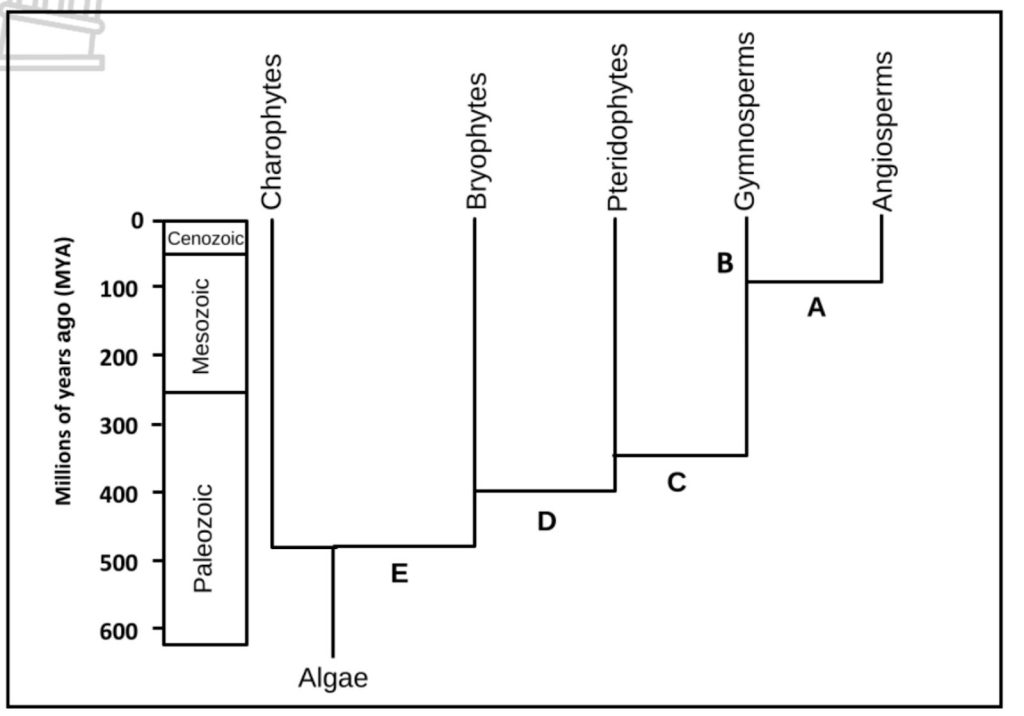
The diagram below represents the development of a group of plants over a period of time.
Life Sciences Grade 11
Question: Name the kingdom to which the algae belongs.
Correct Answer is: Protista
In this context, algae are classified under the Kingdom Protista because they are simple, mostly aquatic, eukaryotic organisms that do not fit fully into the plant, animal, or fungal kingdoms. Although some green algae share characteristics with plants, the broader group of algae contains diverse organisms without true tissues, placing them within Protista. They are important as the ancestral group from which land plants evolved.
Question: Name Two plant divisions that were the first to exist in the Palaeozoic era.
Correct Answer is: Charophytes and Bryophytes
Charophytes are a group of green algae considered the closest relatives of land plants. They appear early in the Palaeozoic era as freshwater organisms with plant-like characteristics. Bryophytes, including mosses, liverworts, and hornworts, are the earliest true land plants. They lack vascular tissue and depend on water for reproduction, showing a transitional stage between aquatic algae and fully terrestrial plants.
Question: State how long ago the seed plants arose on Earth.
Correct answer is: 350 Million Years Ago.
Seed plants emerged around 350 million years ago, marking a major evolutionary advancement. The development of seeds allowed plants to protect their embryos and reproduce without relying on water. This adaptation increased survival on land and enabled plants to colonize diverse environments, leading to the dominance of Gymnosperms and later Angiosperms.
Question: Name One characteristic shared by Gymnosperms and Angiosperms that makes them closely related.
Correct Answer is: Presence of seeds
Both Gymnosperms and Angiosperms produce seeds, placing them in the group called Spermatophytes. Seeds provide protection, nourishment, and improved dispersal for the plant embryo. Although Gymnosperms have exposed (“naked”) seeds and Angiosperms enclose their seeds within fruits, the shared seed trait shows a common ancestry and close evolutionary relationship.
Question: Name the Letter that represents Vascular tissue
Correct Answer is D
Letter D marks the evolutionary point where vascular tissue first appears. This includes xylem and phloem, which allow for efficient transport of water, nutrients, and food. The development of vascular tissue enabled plants like ferns (Pteridophytes) and all later groups to grow larger and survive away from permanently wet environments.
Question: Name the Letter that represents seeds
Correct answer is: C
Letter C represents the point where seed plants (Gymnosperms and Angiosperms) diverge from non-seed plants. This evolutionary step marks the appearance of seeds, a major adaptation that boosted plant survival, reproduction, and spread across terrestrial ecosystems.
Question: Name the group that is considered the ancestor of all land plants from the diagram.
The correct Answer is: Algae
The diagram shows all land plant groups branching from an ancestral lineage linked to algae. In particular, Charophyte algae share structural and biochemical features with land plants, such as similar pigments and patterns of cell division. This indicates that the earliest land plants evolved from a green algal ancestor.
Life Sciences Grade 11
Read and answer the questions below
Tuberculosis (TB) is caused by the bacterium Mycobacterium tuberculosis, which mostly affects the lungs and other organs in the human body. Bacteria are prokaryotic organisms. They survive more in people with a weakened immune system such as people living with the HIV virus. TB is South Africa’s leading cause of death. HIV infection is a key factor in the TB epidemic. HIV sufferers have a higher risk of contracting TB and a greater chance of dying as they have a weaker immune system.”
Question: Name the bacterium that causes TB.
Correct Answer is: Mycobacterium tuberculosis
The passage clearly states that tuberculosis is caused by the bacterium Mycobacterium tuberculosis. This microorganism infects mainly the lungs but can also spread to other organs. It is well known for its slow growth, thick cell wall, and ability to survive inside human cells, which makes TB difficult to treat and control.
Question: State the reasons why bacteria are considered prokaryotic.
Bacteria are considered prokaryotic because
- They lack a nucleus. Bacteria are classified as prokaryotic because their cells do not contain a true nucleus. Instead, their genetic material is found freely in the cytoplasm.
- They do not have membrane-bound organelles. They also lack membrane-bound organelles such as mitochondria, chloroplasts, or the Golgi body. This simple cell structure distinguishes them from eukaryotic organisms like plants, animals, fungi, and protists.
Question: State whether a virus is cellular or acellular.
Correct Answer is: Acellular
Viruses are described as acellular because they do not have the typical components of a living cell. They lack cytoplasm, organelles, and a cell membrane, which means they do not meet the structural requirements of a true cell.
Question: Give a reason for your answer in previous question.
- They are non-living Viruses are considered non-living because they cannot carry out any life processes on their own. They cannot feed, respire, grow, excrete, or reproduce without entering a host cell. This inability to function independently is a key reason they are classified as acellular.
- They lack cellular structures. A virus does not have the basic structures that define a cell. It has no cytoplasm, no cell membrane, and no internal compartments. Because these structures are essential for normal cell functioning, their absence shows that a virus is not a complete cell.
- They do not contain organelles found in normal cells. Viruses have no organelles such as mitochondria, ribosomes, or a nucleus. These organelles are required for important processes like protein synthesis and energy production. Since viruses do not have these organelles, they depend entirely on a host cell to survive and reproduce.
Question: Explain why HIV patients have a higher risk of contracting TB and dying.
HIV patients have a higher risk of contracting TB and dying because of the following reason
- HIV weakens the immune system by reducing white blood cell numbers, making the body unable to defend itself against TB.
- HIV specifically targets and destroys CD4 white blood cells, which are essential for coordinating immune responses. As the immune system becomes weaker, the body cannot effectively fight off infections such as Mycobacterium tuberculosis. This makes H:I:V -positive individuals more likely to become infected with TB and less likely to recover, increasing the risk of severe illness and death.
Read and answer the questions below
Scientists conducted an investigation to determine the effect of different treatments on the amount of fungi that grows on bread.
The procedure was as follows:
- Five slices of bread were used and treated in different ways.
- Slice 1: was left dry
- Slice 2: added 20 ml tap water
- Slice 3: added 20 ml lemon juice
- Slice 4: added 20 ml sugar water
- Slice 5: added 20 ml bleach
- Each slice was placed in a zip-lock bag and kept in a cupboard for one week.
- After one week the slices were removed from the zip-lock bags and were observed the growth of the fungi.
- The percentage area covered by fungi in slices was calculated.
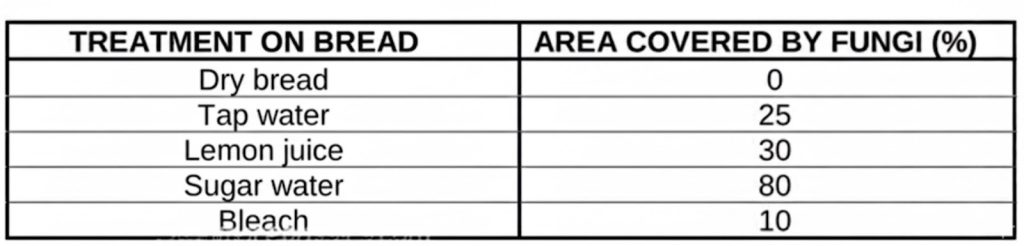
The results are shown in the table below.
Question: Name the independent variable of the investigation.
Correct Answer is: Type of treatment applied to each bread slice
The independent variable is the factor that was deliberately changed by the scientists. In this investigation, each slice received a different treatment—dry, tap water, lemon juice, sugar water, or bleach. This is the only variable that was altered between groups.
Question: Give one reason why the zip-lock bags were placed in a dark cupboard for one week.
Correct Answer is, Fungi grow best in dark, warm conditions
A dark cupboard creates an environment that supports fungal growth by preventing light exposure and keeping temperature fairly constant. These stable conditions help fungi grow more quickly and evenly, allowing accurate comparisons between the treated slices.
Question: Explain why the dry slice was included in the experiment.
The dry slice was included in the experiment for the following reasons
- It acts as a control
The dry bread slice serves as the control because it receives no treatment. This allows scientists to observe how fungi grow under normal, untreated conditions.
- It allows results to be compared with untreated bread
By comparing the treated slices to the untreated dry slice, scientists can determine whether each treatment causes more fungal growth, less growth, or no change at all.
Question: State ways the scientists can improve the reliability of the investigation.
Scientists can improve the reliability of the investigation in the following ways
- Repeat the experiment. Repeating the investigation helps ensure that the results are consistent each time. When results are repeated and remain similar, it shows that the findings are dependable and not due to chance.
- Use more slices for each treatment. Using a larger number of bread slices increases the sample size, which reduces the impact of random variation. This makes the overall results more stable and reliable.
Question: Explain why fungi grows best on bread sprinkled with sugar water.
Fungi grows best on bread sprinkled with sugar water because of the following reasons
- Sugar provides energy/food for fungi. Fungi use sugar as a nutrient source. Sugar is easy for fungi to break down, giving them the energy they need to grow and reproduce quickly.
- More available food allows fungi to grow faster. Because the sugar water increases the amount of food on the bread, the fungi have more resources to support rapid growth. This is why the slice with sugar water shows the highest percentage of fungal coverage.
Question: Give ways the scientists ensured the validity of the investigation.
Scientists ensured the validity of the investigation in the following ways
- All slices were placed in zip-lock bags. Using zip-lock bags keeps the environment around each slice the same by preventing outside air, moisture, or contamination from affecting the results.
- All slices were kept in the same cupboard. Placing all bags in the same cupboard ensures that each slice experiences the same temperature, darkness, and surrounding conditions.
- Each slice remained for one week. Keeping all slices for the exact same duration prevents time differences from affecting how much fungi grow.
- Each slice received exactly 20 ml of treatment. Using the same amount of liquid for each treatment ensures that differences in fungi growth are due to the substance, not the volume.
- Bread slices were the same size. Using equal-sized slices ensures that each piece has the same surface area for fungi to grow on, keeping the comparisons fair.
Life Sciences Grade 11