Life Sciences Grade 11 Exam Revision: Past Paper Questions & Answers 4
Life Sciences Grade 11
Study diagram and answer questions below
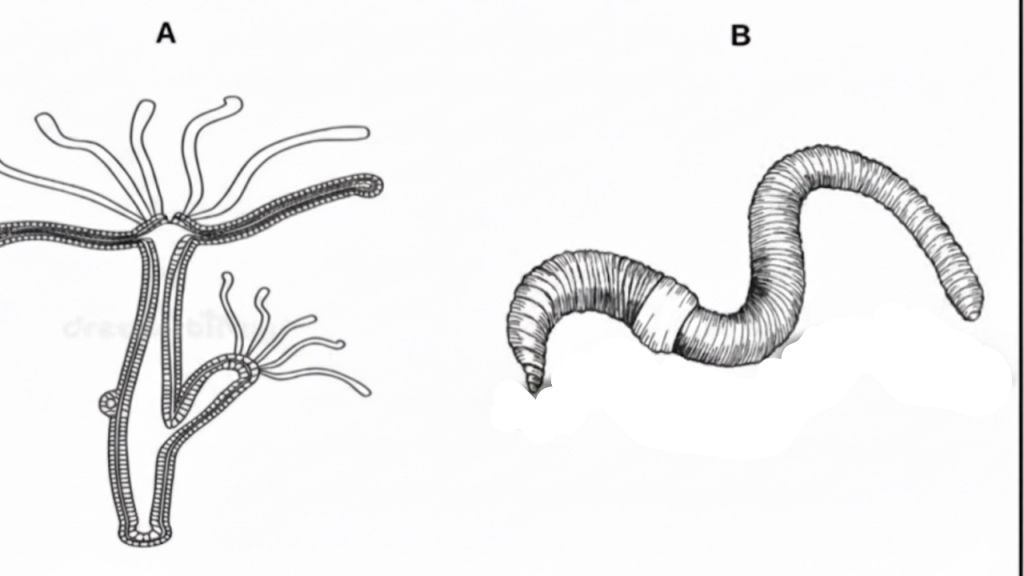
Question: Name the kingdom to which both organisms belong.
Correct Answer is: Animalia
Both organisms show the typical traits of animals: they are multicellular, have organized body structures, and obtain nutrients by feeding rather than producing their own food. These observable features place them in the Kingdom Animalia.
Question: State the phylum to which organism A, belongs.
Correct Answer is Cnidaria
Organism A, has a simple, tubular body with tentacles surrounding its opening. This structure matches the defining features of cnidarians, a group known for their radial body layout and tentacles used for capturing food.
Question: Give the type of symmetry of organism B.
Correct Answer is: Bilateral symmetry
Organism B shows a long, segmented body that can be divided into matching left and right sides along a single line. This mirror-image arrangement is the key feature of bilateral symmetry, which is common in worms and other elongated animals.
Question: Describe the role of organism B as a decomposer.
Correct Answer is: It breaks down dead organic material.
Organism B feeds on decaying leaves and other dead matter in the soil. As it digests this material, it breaks it into simpler substances that enrich the soil. This activity helps recycle nutrients and supports plant growth, making it an important decomposer.
Question: Identify the type of gut in Organism, A
Correct Answer is: Blind gut
Organism A, has only one body opening that serves as both the point where food enters and where waste exits. This single-opening digestive sac is known as a blind gut, a characteristic seen in cnidarians.
Question: Identify the type of gut in Organism B
Correct Answer is: Through gut:
Organism B has a complete digestive system with two separate openings: a mouth for taking in food and an anus for releasing waste. This through-gut arrangement allows food to move in one direction and be processed efficiently.
A mycorrhiza is a mutualistic relationship between fungal hyphae and the roots of true plants. The hyphae increase the absorptive surface of the plants roots by aiding in the absorption of water, phosphorus and other mineral ions from the soil to the roots of plants. The plant is photosynthetic and provides the fungus with carbohydrates.
Scientists conducted an investigation to determine the effect of mycorrhizal associations on plant growth.
The procedure for the investigation:
• Two groups of plants of the same species were grown.
• GROUP A: was planted in a soil that had been sterilised.
• GROUP B: was planted in the same type of soil but not sterilised.
• The plants were allowed to grow for 10 weeks.
• Each week, the height (in centimetres) of plant was measured.
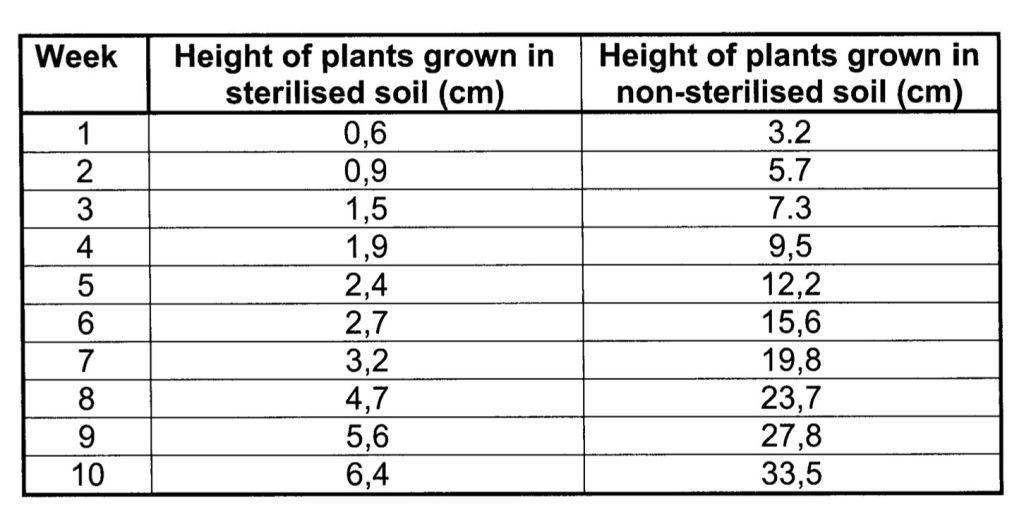
The table below shows the growth of the plants over the 10-week period
Question: Identify the independent variable.
The independent variable in this investigation is the presence or absence of mycorrhizal association. This variable was deliberately changed by growing plants in sterilised soil and non-sterilised soil to observe its effect on plant growth.
Question: Identify the planning steps for the investigation.
One important planning step was deciding on the time period for the investigation. The scientists planned that the plants would be grown and measured over a fixed period of ten weeks, ensuring sufficient time for growth differences to be observed.
Another planning step was deciding on the sample size. The scientists had to determine how many plants would be used in each group to ensure that the results would be reliable and representative.
A further planning step was deciding how results would be recorded, specifically by measuring plant height weekly in centimetres.
Question: State Two factors that were kept constant during the investigation.
One factor that was kept constant was the duration of growth. All plants in both groups were grown for the same period of ten weeks, ensuring that time did not influence the results.
Another factor that was kept constant was the species of plant used. Using the same plant species ensured that any differences in height were due to soil conditions and not genetic differences between plants.
A third factor kept constant was the type of soil used, with both groups grown in soil of the same type, differing only in whether it was sterilised or not.
Question: Calculate the percentage increase in plant height between week 8 and week 10 in sterilised soil. Show all workings.
- The height of the plant at week eight was 4.7 cm, while the height at week ten was 6.4 cm.
- To find the increase in height, the height at week eight is subtracted from the height at week ten. (6.4 – 4.7 = 1.7) This gives an increase of 1.7cm.
- To calculate the percentage increase, the increase in height is divided by the original height at week eight. The answer is then multiplied by one hundred. Hence 1.7 /4.7 x 100 = 36%
- The percentage increase in plant height is therefore thirty six percent.
Question: What conclusion can be drawn from the results of the investigation?
The results show that plants grown in non-sterilised soil grew much taller than those grown in sterilised soil. This indicates that the presence of mycorrhizal fungi in the soil enhances plant growth by improving the absorption of water and mineral nutrients.
Alternatively, it can be concluded that plants grown in sterilised soil show reduced growth because they lack mycorrhizal fungi that assist with nutrient uptake.
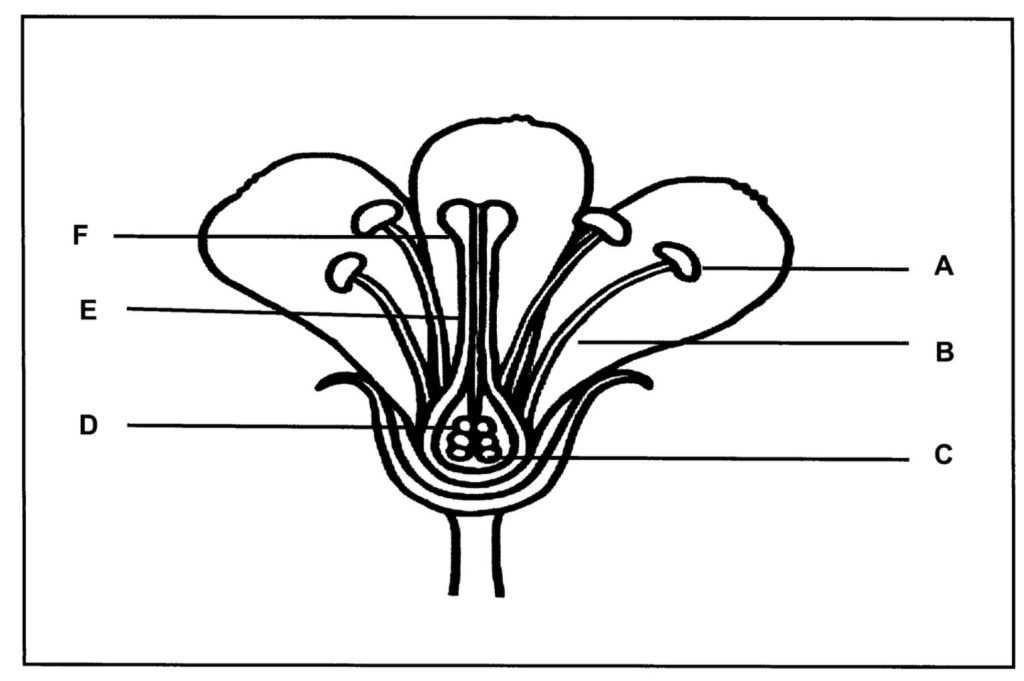
The diagram below shows a flower
Question: Identify part D of the flower.
Part D is the ovary. The ovary is the enlarged base of the carpel and contains the ovules. It plays an essential role in reproduction because it later develops into the fruit after fertilisation.
Question: Identify part E of the flower.
Part E is the style. The style is a narrow stalk that connects the stigma to the ovary and provides a pathway for the pollen tube to grow during fertilisation.
Question: Identify part F of the flower.
Part F is the stigma. The stigma is the sticky tip of the carpel that receives pollen grains during pollination.
Question: What name is given to parts A and B together?
Parts A and B together are called the stamen. The stamen is the male reproductive part of the flower and consists of the anther, which produces pollen, and the filament, which supports the anther.
Question: Give the Letter and Name of the part that becomes a seed after fertilisation.
The part that becomes a seed after fertilisation is C, the ovule. After fertilisation, the ovule develops into a seed containing the embryo of the new plant.
Question: State Two functions of flowers.
- One function of flowers is to attract pollinators, such as insects or birds, which helps transfer pollen for fertilisation.
- Another function of flowers is to produce and protect the reproductive organs, ensuring successful fertilisation and the formation of seeds.
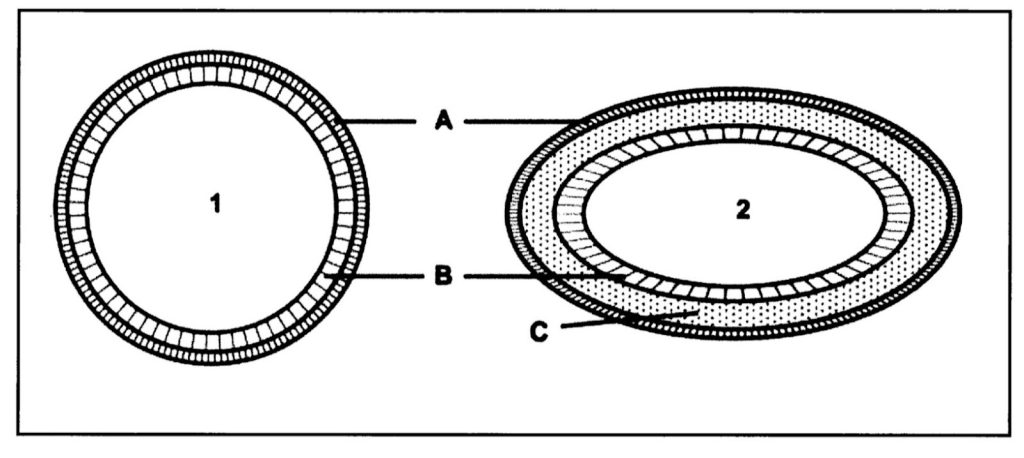
Study the diagram below showing the arrangement of body tissues.
Question: Identify Part A
Part A, is the ectoderm. The ectoderm is the outer germ layer and gives rise to structures such as the skin, nervous system, and sense organs.
Question: Identify Part B
Part B is the endoderm. The endoderm is the inner germ layer and forms the lining of the digestive tract and associated organs involved in digestion and absorption.
Question: Identify Part C
Part C is the mesoderm. The mesoderm is the middle germ layer and develops into muscles, bones, blood vessels, and many internal organs.
Question: Which organism,1 or 2, is diploblastic?
Organism 1 is diploblastic. A diploblastic organism develops from only two germ layers during embryonic development.
Question: Provide a reason for your answer in above question.
Organism 1 is diploblastic because it consists of only two germ layers, namely the ectoderm and the endoderm, and does not have a mesoderm layer.
Question: Explain the disadvantages of lacking a fluid-filled cavity (coelom) with regard to an organism’s nutrition.
- When an organism lacks a coelom, the gut wall is not separated from the body wall, which limits the expansion and movement of the digestive system and reduces the efficiency of digestion.
- The absence of a coelom also restricts the internal transport of nutrients because there is no fluid-filled space to allow nutrients to move freely through the body.
Question: Name an organism with the tissue layer arrangement indicated by Diagram 1.
An organism with the tissue layer arrangement shown in Diagram 1 is a cnidarian, such as a hydra or a jellyfish.
Question: Describe the differences between Organism 1 and Organism 2 with regard to their symmetry.
Organism 1 has radial symmetry, meaning its body parts are arranged around a central axis and can be divided into similar halves in more than one plane while Organism 2 has bilateral symmetry, meaning its body can be divided into two equal mirror-image halves along a single longitudinal plane.
Life Sciences Grade 11