Life Science Grade 11 Photosynthesis
All living organisms, from bacteria to humans, need energy to survive. Many organisms get this energy by eating other organisms, but the original source of energy in food comes from photosynthesis.
Photosynthesis is crucial to all life on Earth because it is the only process that captures sunlight and converts it into chemical energy stored in carbohydrates. These carbohydrates, such as sugars, are used by all organisms to fuel their metabolic processes.
Only certain organisms, like plants, algae, and some bacteria (such as cyanobacteria), can perform photosynthesis. These organisms are known as photoautotrophs because they create their own food using light. In contrast, organisms like animals, fungi, and most bacteria are called heterotrophs, as they rely on consuming sugars made by photoautotrophs for energy
Process of Photosynthesis
The word “photosynthesis” is derived from two Greek words: ‘photo’, meaning light, and ‘synthesis’, meaning to produce. This reflects the process where light energy is used to produce food for the plant.
Photosynthesis is a complex process that takes place in the chloroplasts of green plants. Chloroplasts contain chlorophyll, a green pigment that plays a vital role in capturing radiant energy from the sun. This energy is then used to convert carbon dioxide (CO₂) from the atmosphere and water (H₂O) from the soil into carbohydrates, particularly glucose (C₆H₁₂O₆). The glucose produced is either used immediately by the plant as an energy source or stored for later use.
Key Steps (Process) in Photosynthesis
Absorption of Light Energy:
The process of photosynthesis begins when chlorophyll, the green pigment in the chloroplasts, absorbs sunlight. This light energy is crucial as it powers the chemical reactions that convert carbon dioxide (CO₂) and water (H₂O) into glucose. Without sunlight, these reactions cannot occur, and energy cannot be captured or stored.
Carbon Dioxide and Water Intake:
Plants absorb carbon dioxide from the atmosphere through small openings on their leaves called stomata. At the same time, water is taken in through the plant’s roots and transported to the leaves via xylem, which is a specialized tissue that moves water upwards from the soil.
Production of Glucose:
Inside the chloroplasts, the absorbed radiant energy is used to break down water molecules into hydrogen and oxygen. The hydrogen atoms combine with carbon dioxide in a series of reactions to form glucose, a simple sugar that the plant uses for energy and growth.
Release of Oxygen:
As the water molecules are split during the process, oxygen is produced as a byproduct. This oxygen is released back into the atmosphere through the stomata. This release of oxygen is essential for all aerobic organisms (those that require oxygen for survival), including humans.
Role of Enzymes:
Enzymes are vital in the process of photosynthesis, as they help to speed up the chemical reactions that transform carbon dioxide and water into glucose. Without these enzymes, the reactions would occur too slowly to support the needs of the plant.
Glucose Conversion to Starch:
Any excess glucose that the plant does not immediately use is converted into starch. Starch is a long-term energy storage molecule that the plant can break down and use when necessary, such as during periods of low light or at night when photosynthesis cannot occur.
Photosynthesis Equation:

This equation represents the entire process of photosynthesis, showing how plants transform carbon dioxide, water, and light energy into glucose (a sugar) and oxygen.
Photosynthesis in Plants
In plants, photosynthesis primarily occurs in the leaves, which are made up of several layers of cells. The actual process takes place in a middle layer called the mesophyll. For photosynthesis to happen, gas exchange is crucial, and this exchange of carbon dioxide (CO₂) and oxygen (O₂) occurs through small openings called stomata (singular: stoma). These stomata also help regulate the plant’s gas exchange and water balance. They are typically located on the underside of the leaf to minimize water loss. Each stoma is controlled by guard cells, which can open or close the stomata by swelling or shrinking in response to water movement within the cells.
In all autotrophic eukaryotes (organisms that produce their own food), photosynthesis happens inside a specialized structure called the chloroplast. In plants, these chloroplasts are found in the mesophyll cells. Each chloroplast has a double membrane that consists of an outer and an inner membrane. Inside the chloroplasts are structures called thylakoids, which are stacked like discs. These stacks are known as grana (singular: granum).
The thylakoid membrane contains chlorophyll, a pigment that absorbs sunlight and initiates the photosynthesis process. This membrane also houses various proteins that make up the electron transport chain, a key part of converting light energy into chemical energy. The space inside the thylakoid is called the thylakoid lumen, while the liquid-filled space surrounding the grana is known as the stroma. It’s important not to confuse stroma (the liquid) with stoma (the opening on the leaf’s surface).
Figure 1: Diagram showing the requirements and products of photosynthesis
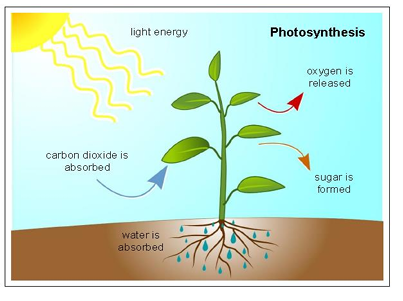
Figure 1: Diagram showing the requirements and products of photosynthesis

- Double Membrane: Protects and regulates the movement of substances into and out of the chloroplast.
- Granum: Increases the surface area for light absorption, facilitating efficient photosynthesis.
- Lamella: Connects and supports the thylakoid stacks (grana), aiding in the organization and material exchange necessary for photosynthesis.
- Stroma: Provides the fluid environment for the Calvin cycle, where carbon dioxide is converted into glucose.
- Intergranum Lamella: Connects different grana, ensuring continuous thylakoid membrane networks for efficient photosynthetic processes
Ligh Light and Dark Phase
The process of photosynthesis occurs in two phases:
- Light phase: light is required
- Dark phase: no light is required
The Light Phase
Phase Location
The light phase of photosynthesis takes place in the grana, which are stacks of thylakoid membranes found within the chloroplasts. These structures are critical because they house the chlorophyll molecules, which are essential for capturing sunlight.
Absorption of Sunlight
During the light phase, chlorophyll in the grana absorbs radiant energy from the sun. This energy is then converted into chemical energy through a series of complex reactions. The absorbed sunlight excites electrons in the chlorophyll molecules, initiating the process of energy transformation.
Water Splitting (Photolysis)
The chemical energy produced in the light phase is used to split water molecules (H₂O) into hydrogen atoms and oxygen atoms, a process known as photolysis. This reaction occurs in the thylakoid membranes and results in the formation of energy-rich hydrogen atoms and oxygen. The oxygen atoms are released into the atmosphere as a byproduct, while the hydrogen atoms are transferred to the dark phase of photosynthesis.
Transfer of Energy-Rich Hydrogen Atoms
The hydrogen atoms, now rich in energy, are transported from the light phase to the dark phase of photosynthesis. These hydrogen atoms will be used in the dark phase to drive the synthesis of glucose, which is a key product of photosynthesis.
Oxygen Release
As a result of photolysis, oxygen is released into the atmosphere. This release is an important aspect of photosynthesis because it provides the oxygen necessary for respiration in living organisms.
ATP Formation
In addition to producing hydrogen and oxygen, the light phase also generates ATP (adenosine triphosphate). ATP acts as an energy carrier and is crucial for the dark phase of photosynthesis. The energy from the sunlight drives the synthesis of ATP, which will be used to fuel the biochemical reactions in the dark phase.
Dark Phase of Photosynthesis
- The dark phase, or Calvin cycle, occurs in the stroma of chloroplasts.
- During this phase, carbon dioxide is absorbed from the atmosphere and combines with energy-rich hydrogen atoms from the light phase.
- Energy from ATP, produced during the light phase, is used to drive this process.
- The end product is glucose, an energy-rich carbohydrate.
- Excess glucose is stored as starch in the plant.
Importance of Photosynthesis
- Photosynthesis helps maintain a constant oxygen level in the atmosphere and water, which is crucial for cellular respiration in living organisms.
- It also keeps the carbon dioxide levels stable by absorbing CO₂ released by organisms during respiration.
- Photosynthesis is the primary source of food for heterotrophic organisms that cannot produce their own energy.
ATP as an Energy Carrier in Cells
- ATP serves as the primary energy carrier in cells. When cells need energy, ATP is broken down, releasing the energy stored in its chemical bonds.
- This energy is used by cells to produce important molecules like proteins and fats.
- Muscle cells rely on ATP for contraction, which is essential for movement.
- ATP also provides the energy required for moving substances across cell membranes.
Factors Influencing the Rate of Photosynthesis
Light Intensity
- Low Light Intensity and Slow Photosynthesis: At low levels of light intensity, the rate of photosynthesis is slow because light is a key energy source for the process. Photosynthesis depends on the absorption of light energy by chlorophyll to drive the reactions that convert carbon dioxide and water into glucose and oxygen. When light intensity is low, there is not enough energy to power these reactions efficiently, which slows down the overall rate of photosynthesis.
- Increasing Light Intensity and Higher Photosynthesis Rate: As light intensity increases, more energy is available for chlorophyll to absorb. This increased energy boosts the rate at which the light-dependent reactions of photosynthesis occur. More light means more ATP and NADPH are produced, which are then used in the Calvin cycle to produce glucose. As a result, the rate of photosynthesis increases with light intensity. However, this increase is not infinite.
- Optimum Light Intensity and Limiting Factors: Photosynthesis will only increase with light intensity up to a certain point, known as the optimum light intensity. Once this optimum level is reached, the rate of photosynthesis levels off. This is because other factors, such as carbon dioxide concentration or temperature, may become limiting. Even though there is plenty of light, the plant cannot increase its rate of photosynthesis without sufficient amounts of CO₂, proper temperature, or nutrients. Beyond the optimum light intensity, photosynthesis cannot proceed any faster, no matter how much light is available.

Carbon Dioxide (CO2) Concentration and Photosynthesis
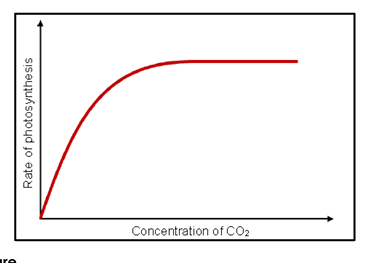
Low CO₂ Concentration: At a low concentration of carbon dioxide, the rate of photosynthesis is minimal. This is because CO₂ is one of the key reactants in the photosynthesis process.
Increasing CO₂ Concentration: As the concentration of CO₂ increases, the rate of photosynthesis also rises. This happens because more carbon dioxide is available to be used in the Calvin cycle during photosynthesis.
Optimum CO₂ Concentration: Photosynthesis increases with rising CO₂ levels only up to a certain optimal point. Once the optimum CO₂ concentration is reached, increasing CO₂ further will not result in a faster rate of photosynthesis; instead, it will level off and remain constant.
Higher than Optimum CO₂: If the CO₂ concentration exceeds the optimum, the rate of photosynthesis will no longer increase and remains constant. This suggests that other factors, like light intensity or temperature, may become limiting factors.
Graph Representation:
A line graph shows how increasing carbon dioxide concentration initially increases the rate of photosynthesis before levelling off after reaching the optimum point.
Temperature and Its Effect on Photosynthesis
- Low Temperature and Slow Photosynthesis:
- At low temperatures, the rate of photosynthesis is slow. This is because enzymes, which are proteins that catalyze the chemical reactions involved in photosynthesis, become less active. Enzymes rely on kinetic energy to collide with substrate molecules (such as CO₂ and H₂O), but at low temperatures, there is insufficient kinetic energy, leading to slower reaction rates. As a result, the overall process of photosynthesis proceeds at a reduced rate.
- Increasing Temperature and Faster Photosynthesis:
- As temperature increases, so does the rate of photosynthesis. Higher temperatures provide more energy to the enzymes, increasing the number of successful collisions between enzymes and substrates. This causes the light-dependent and light-independent (Calvin cycle) reactions to occur more rapidly, boosting the overall rate of photosynthesis. The rise in temperature speeds up enzyme activity, leading to a more efficient conversion of carbon dioxide and water into glucose and oxygen.
- Higher than Optimum Temperature and Decreasing Photosynthesis:
- If the temperature rises above the optimum level (the temperature at which enzymes work most efficiently), the rate of photosynthesis will start to decrease. This is due to enzyme denaturation. Enzymes are sensitive to temperature, and when exposed to high temperatures, they lose their three-dimensional structure and their active sites become altered. Once enzymes denature, they can no longer bind to their substrates, rendering them ineffective in catalyzing the reactions needed for photosynthesis. As a result, photosynthesis slows down significantly or even stops.
- Enzyme Inactivity at Low Temperatures:
- At extremely low temperatures, enzymes involved in photosynthesis can become inactive. This means that they are not entirely denatured, but they have insufficient energy to function effectively. When this happens, the plant’s metabolic processes slow down to a point where photosynthesis is almost negligible. Only when temperatures rise again can the enzymes regain their activity, and photosynthesis can resume at a faster rate.
Religious studies grade 12 Revision 3
The Role of Optimum Light, Temperature, and Carbon Dioxide in a Greenhouse to Improve Crop Yield
- Greenhouse Environment: A greenhouse is a specialized structure, typically with a glass or plastic roof, designed to create an ideal environment for growing plants, such as tomatoes. It works by trapping warm air inside, thus maintaining a controlled climate.
- Light Intensity: Providing optimum light intensity is crucial as it directly affects the rate of photosynthesis, which is the process through which plants convert light into energy for growth. Adequate light enhances photosynthesis, leading to faster and more robust plant growth.
- Temperature Regulation: Maintaining an optimal temperature within the greenhouse is essential. The right temperature range supports efficient photosynthesis and overall plant development. Extreme temperatures, whether too hot or too cold, can hinder plant growth and reduce crop yield.
- Carbon Dioxide Levels: During photosynthesis, plants consume carbon dioxide (CO₂) from the air, which can lower its concentration inside the greenhouse. To counteract this, CO₂ can be artificially introduced into the greenhouse to sustain high photosynthesis rates and promote better growth. This controlled increase in CO₂ helps optimize plant productivity.
Experiment to Demonstrate that Light is Necessary for Photosynthesis
- Destarching the Plant: Place a potted plant in a dark cupboard for 48 hours to ensure it uses up all its stored starch.
- Preparing the Leaf: Cover a portion of a leaf, while it is still attached to the plant, with tinfoil.
- Exposure to Light: Move the plant to a sunny location and leave it there for 48 hours.
- Testing the Leaf: After the exposure period, pick the leaf and remove the tinfoil.
- Iodine Staining:
- Test the leaf for the presence of starch by applying iodine solution.
- The iodine solution will turn blue-black in areas that were exposed to light, indicating the presence of starch.
- The iodine solution will remain light brown in the area covered by tinfoil, indicating the absence of starch.
4o mini