Life Sciences Grade 10 Revision 1 | Past Paper Questions & Answers Explained
Life Sciences Grade 10
In the diagram below the letters A, B and C represents Three groups of organic compounds that you have studied.
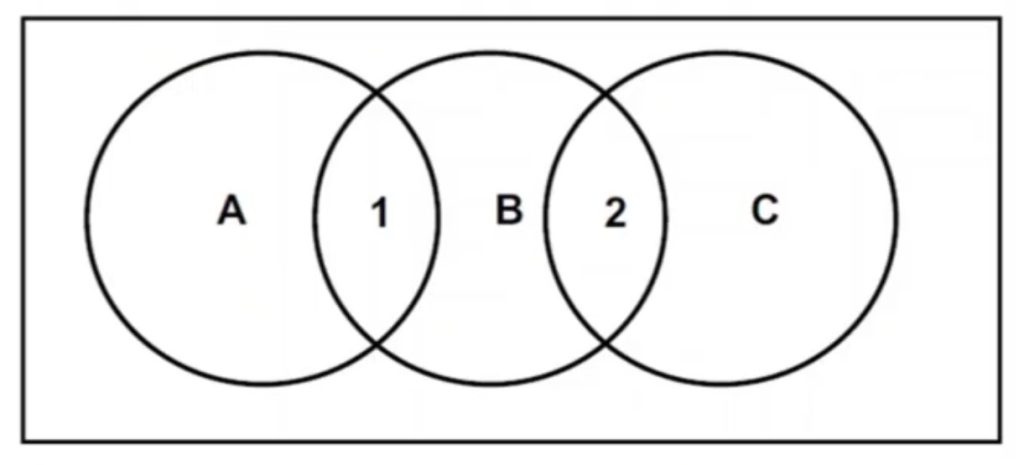
• Number 1 represents characteristics common to A, and B only.
• Number 2 represents characteristics common to B and C only.
• B and C make up a cell membrane.
• C is made up of amino acids.
Question: Define an organic compound.
Correct answer is: An organic compound is a compound that contains carbon and usually hydrogen, often combined with oxygen.
Organic compounds form the basis of living organisms and include molecules such as carbohydrates, lipids, and proteins, all built around carbon atoms.
Question: Name the organic compound labelled A.
Correct answer is: Carbohydrates
These are energy-providing molecules made of carbon, hydrogen, and oxygen, and they include sugars and starches.
Question: Name the organic compound labelled B.
Correct answer is: Lipids (fats)
Lipids are hydrophobic molecules that store energy and form major structural parts of cell membranes.
Question: Name the organic compound labelled C.
Correct answer is: Proteins
Proteins perform many roles in cells and are made from long chains of amino acids folded into specific shapes.
Question: Name the monomers of carbohydrates.
Correct answer is: Monosaccharides
These simple sugars—such as glucose—are the basic units used to build larger carbohydrate molecules.
Question: Name the monomers of lipids.
Correct answer is: Fatty acids and glycerol
A typical lipid such as a triglyceride consists of three fatty acids linked to one glycerol molecule.
Question: Name the monomers of proteins.
Correct answer is: Amino acids
Amino acids join in long chains called polypeptides, which fold to form functional proteins.
Question: Which organic compound (A, B, or C) is stored in the human liver in the form of glycogen?
Correct answer is: A, (Carbohydrates)
Glycogen is a polysaccharide made from many glucose molecules and serves as the main carbohydrate storage form in liver and muscle cells.
Religion Studies Grade 10 : Study Guide | Past Paper Questions and Answers | Revision 2
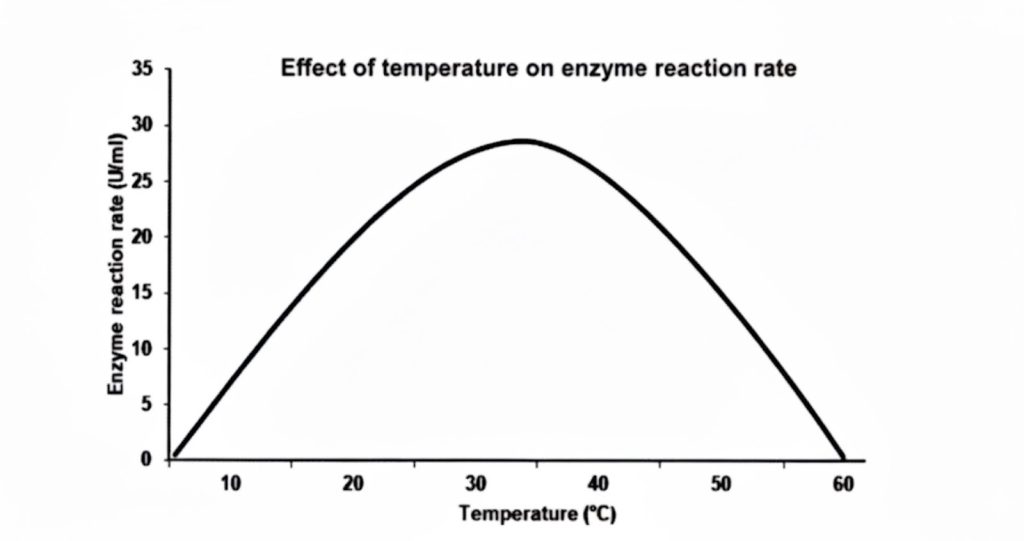
The graph below shows the results of an investigation that was conducted by grade 10 learners to determine the effect of temperature on enzyme rate of reaction.
Question: Identify the dependent variable.
Correct answer is: The enzyme reaction rate.
The enzyme reaction rate is measured during the investigation, meaning it changes in response to the temperature and shows how well the enzyme is working at each point.
Question: Identify the independent variable.
Correct answer is: Temperature.
Temperature is the factor that the learners intentionally changed during the investigation in order to observe how it affects the enzyme’s activity.
Question: State the aim of the investigation.
Correct answer is: To determine the effect of temperature on the enzyme reaction rate.
The aim focuses on finding out how different temperatures influence how quickly the enzyme works, helping learners understand the relationship between temperature and enzyme activity.
Question: Using information from the graph, explain why 35 degrees Celsius is considered the optimum temperature for the enzyme reaction rate.
Correct answer is: 35 degrees Celsius is the optimum temperature because the enzyme reaction rate reaches its highest value at this point.
At 35 degrees Celsius , the enzyme works at maximum efficiency, shown by the peak of the graph. When the temperature increases or decreases from 35 degrees Celsius , the reaction rate drops, showing reduced enzyme activity.
Question: List ways in which the reliability of the investigation could be improved.
The reliability of the investigation could be improved in the following ways
- Repeat the investigation several times and calculate an average.
- Increase the number of trials or samples tested at each temperature.
Repeating the investigation reduces the influence of errors or unusual results, while using more samples makes the findings more consistent and trustworthy.
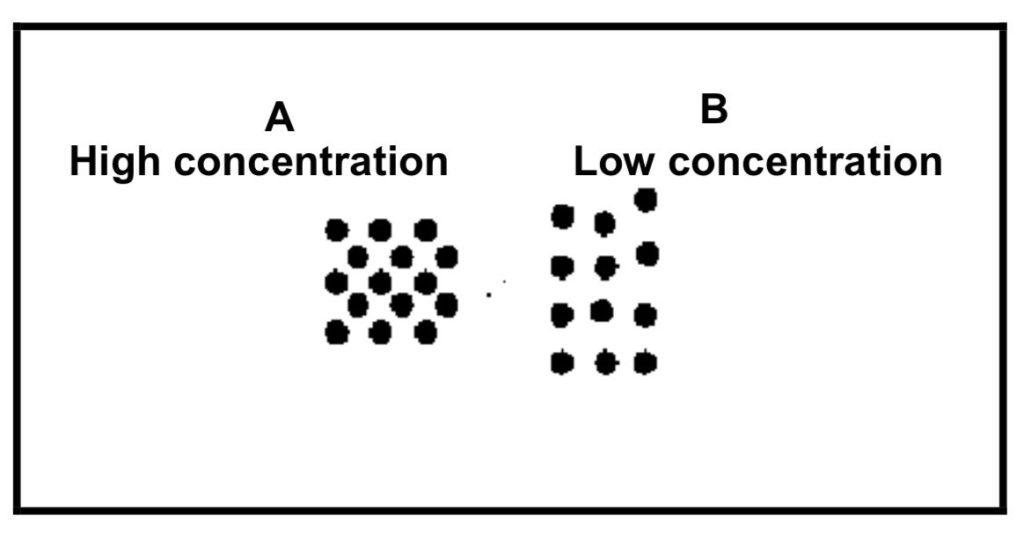
The diagram below shows a certain process taking place in plants and animal cells.
Question: Identify the above process.
The process shown is Diffusion.
Diffusion is the passive movement of particles, such as molecules or ions, from an area of higher concentration to an area of lower concentration. It occurs due to the natural kinetic energy of particles, which causes them to move randomly. Over time, this random movement leads to a net flow from regions of high concentration to low concentration, eventually reaching equilibrium, where particles are evenly distributed. This process is essential for the transport of substances like oxygen, carbon dioxide, and nutrients in both plant and animal cells.
Question: State whether the process mentioned in above question is an active or a passive process?
The process is a Passive process.
Diffusion is classified as a passive process because it does not require energy input from the cell. The movement of particles occurs naturally along the concentration gradient, from high to low concentration. Unlike active transport, which uses energy to move substances against the gradient, diffusion relies purely on the intrinsic motion of molecules. This makes it a fundamental process for maintaining cellular homeostasis efficiently.
Question: State whether the particles are likely to move from diagram A to B or diagram B to A?
The particles are likely to move from diagram A to B.
In the diagram, diagram A has a higher concentration of particles compared to diagram B. Because diffusion always moves substances from areas of high concentration to areas of low concentration, particles will naturally migrate from A to B. This movement continues until the concentrations in both regions are equal, achieving equilibrium.
Question: Give a reason for your answer in previous question
Diagram A has a high concentration of particles/molecules. Particles/molecules move from an area of high concentration to an area of low concentration during diffusion, which is the net movement required to reach equilibrium.
The driving force behind diffusion is the concentration gradient. Molecules in high concentration collide more frequently and spread out toward the lower concentration region. This process allows cells to exchange gases, absorb nutrients, and remove wastes efficiently without expending energy, which is crucial for the survival and functioning of both plant and animal cells.
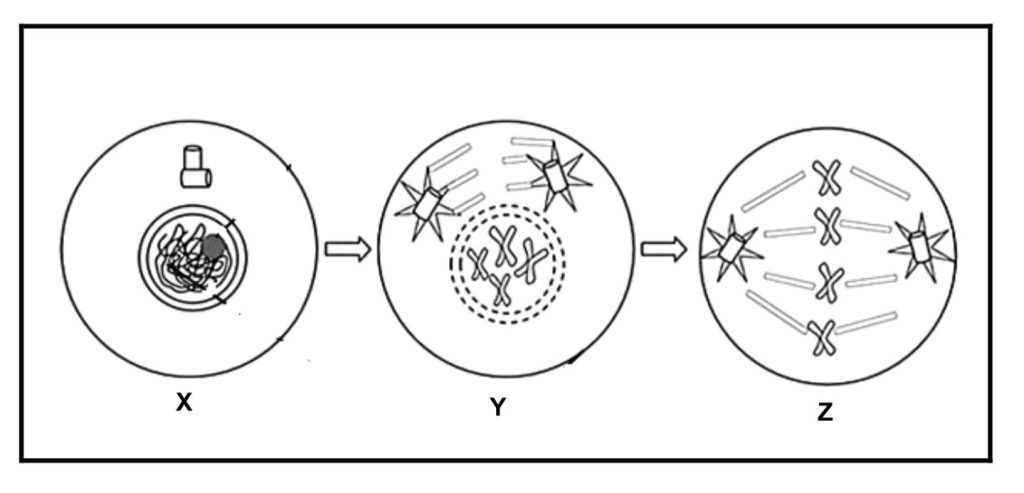
The diagrams below show some of the phases of mitosis
Question: Identify the phase shown in diagram Z.
The correct answer is: Metaphase
Metaphase is the stage of mitosis in which chromosomes move to the centre of the cell. They arrange themselves along an imaginary line called the equator. Spindle fibres from opposite poles attach to the chromosomes and hold them in position. This arrangement is important because it ensures that, when the chromosomes separate later, each daughter cell will receive an identical set of genetic material. The clear line of chromosomes across the middle makes this phase easy to identify.
Question: Give one visible reason for your answer in the previous question.
The visible reason to justify diagram Z as metaphase is: Chromosomes are lined at the equator.
All the chromosomes are seen in a straight line across the centre of the cell. This occurs because spindle fibres pull the chromosomes evenly from both sides, showing that the cell is ready for the next stage of mitosis.
Question: Name the process that takes place in the phase shown in diagram X.
The correct answer is: DNA replication
Diagram X represents interphase. During this phase, the cell prepares for division by copying its DNA. Each chromosome is duplicated so that it consists of two identical sister chromatids.
Question: Explain the importance of the process named in the previous question.
DNA replication ensures that genetic material is doubled so that it can be shared equally between the two daughter cells
By duplicating the DNA before mitosis, the cell ensures that each daughter cell receives a complete and identical set of chromosomes. This is essential for normal growth, tissue repair, and proper cell function.
Question: Describe the events that take place in the phase shown in diagram Y.
During prophase, the chromatin shortens and thickens, making the chromosomes visible. The nuclear membrane begins to disappear, allowing the chromosomes to move freely. In animal cells, centrioles move to opposite poles of the cell, and spindle fibres start forming between them. These changes prepare the cell for chromosome alignment in metaphase.
Question: How many chromosomes will be present in each cell of telophase?
The correct answer is: 4 chromosomes
The parent cell has 4 chromosomes. After the sister chromatids separate and new nuclei form, each daughter cell in telophase contains the same number of chromosomes as the original cell, ensuring genetic continuity.
A group of Grade 10 learners conducted an experiment to test for the presence of certain nutrients on different food. The apparatus was set up as follows
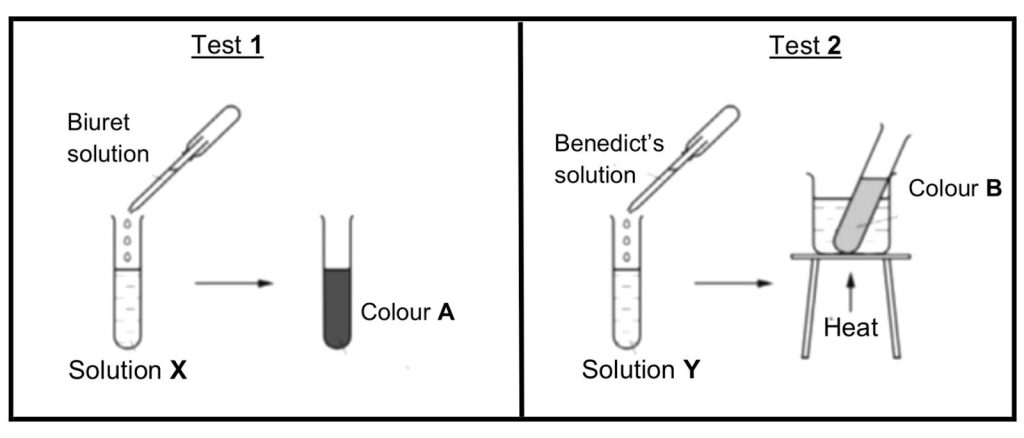
Question: Name the nutrient tested for in Test 1
Correct Answer is: Protein
Test 1 is used to detect proteins in a food sample. Proteins are vital nutrients needed for growth, repair of body tissues, and the production of enzymes and hormones that regulate body processes.
Question: Name the nutrient tested for in Test 2
Correct Answer is: Glucose
Test 2 is used to identify glucose, a simple sugar that serves as a primary source of energy for cells. The presence of glucose is shown by a colour change when the appropriate chemical reagent is added and heated
Question: State the colour B for positive results in the above investigation.
The Correct Answer is: Orange-brown / Red-brown
A colour change to orange-brown or red-brown indicates a positive result for glucose. This shows that glucose is present in the food sample after it reacts with the testing solution during heating.
Question: List steps that were followed in the planning of the experiment above
1, Decide on the time and venue of the experiment
Planning when and where the experiment will take place ensures that there is enough time to complete all procedures and that the environment is suitable and safe for conducting the investigation.
2, Decide on the sample size
Choosing the number of samples to be tested helps ensure that the results are reliable and representative. Using an appropriate sample size reduces the influence of chance and improves accuracy.
3, Decide on the type of food to be tested
Selecting the food samples in advance ensures that the investigation targets the nutrients being tested. This helps produce meaningful and relevant results.
4, Decide on the apparatus to be used
Identifying the required apparatus beforehand ensures that the correct equipment is available and used properly. This allows the experiment to be carried out accurately and safely.
5, Decide on the chemicals to be used
Choosing the correct chemicals is essential for detecting specific nutrients. Using appropriate reagents ensures that colour changes are clear and that the test results are valid.
Question: State ways in which the reliability of the experiment could be improved.
Reliability refers to the consistency of results. The reliability of the experiment can be improved in the following ways
1, Increase the sample size
Using a larger number of samples reduces the effect of random variation. When more samples are tested, the results are more representative and consistent, which improves the reliability of the investigation.
2, Repeat the experiment or perform more tests
Repeating the experiment allows scientists to check whether similar results are obtained each time. Consistent results from repeated trials increase confidence that the findings are dependable and not due to chance
The diagram below shows an animal cell
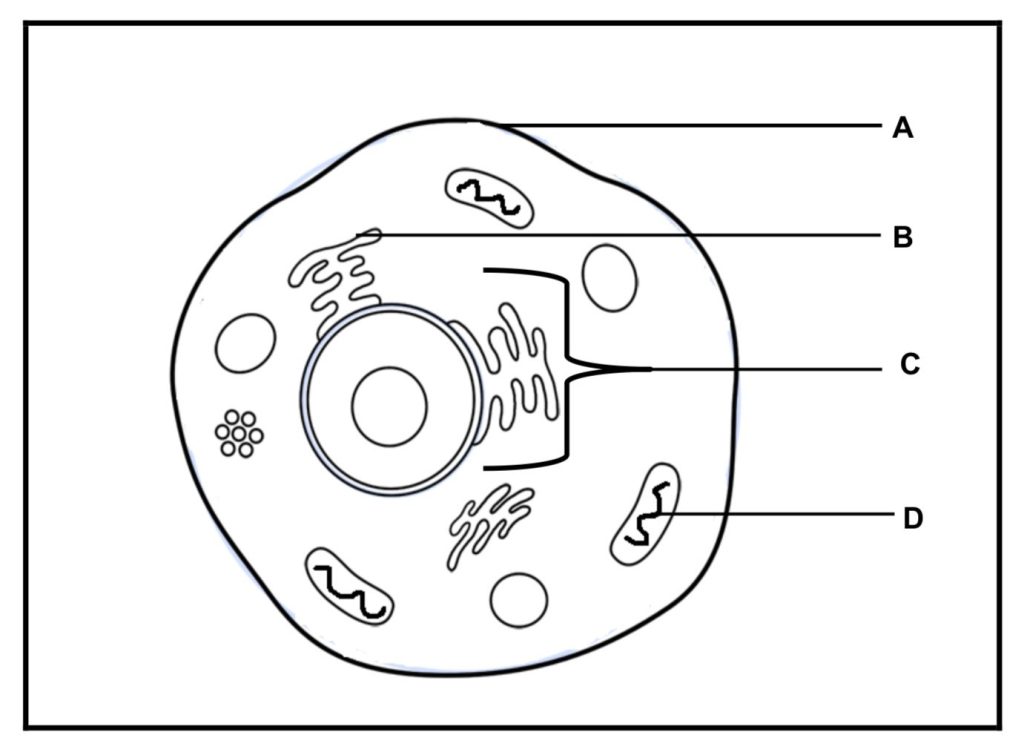
Question: Give the letter and name of the part that controls substances coming into and out of the cell.
The part labelled A is the cell membrane. The cell membrane surrounds the cell and is selectively permeable, meaning it regulates the movement of substances into and out of the cell. This control allows essential nutrients to enter while waste materials are removed, helping the cell maintain a stable internal environment.
Question: State One function of part B.
Part B is responsible for transporting large molecules within the cytoplasm. This structure forms part of the internal membrane system of the cell and allows substances such as proteins to be moved efficiently from one area of the cell to another.
Question: Explain the role of part D in the cell.
Part D is the site of cellular respiration. It releases energy from food during respiration and provides the cell with energy needed for vital processes such as growth, movement, and repair. Without this structure, the cell would not be able to function effectively.
Question: Explain the importance of part C in paternity testing of a child.
Part C contains DNA, which carries hereditary information. This genetic material is inherited from both parents and is unique to each individual. In paternity testing, the DNA found in the nucleus of the child is compared with that of the potential father to determine whether there is a genetic match.
The diagram below show a cell organelle
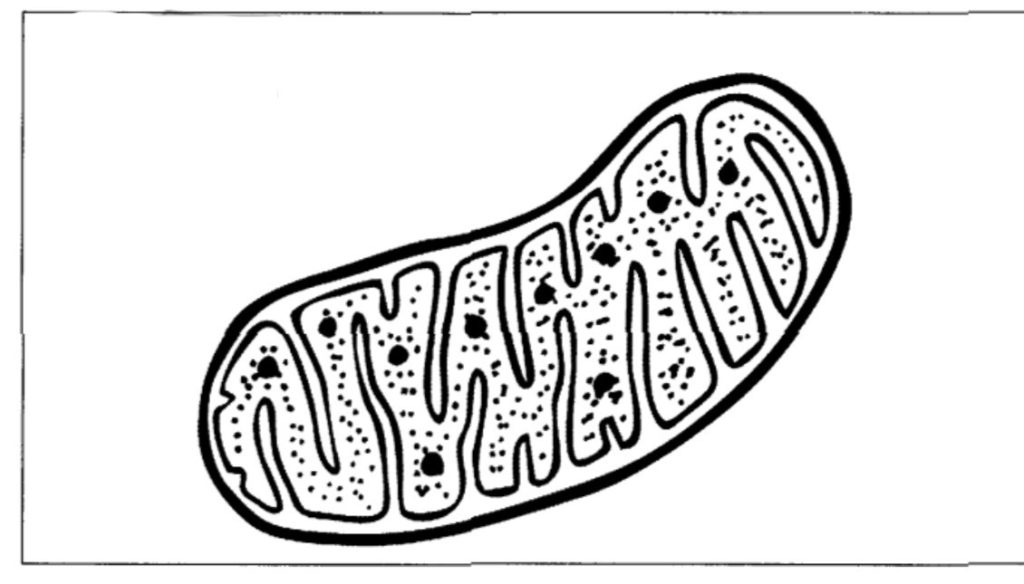
Question: Identify the cell organelle shown in the diagram.
The diagram shows a mitochondrion. This organelle is responsible for releasing energy needed by the cell to carry out its activities.
Question: State Two places where this organelle is found.
The mitochondrion is found in animal cells and plant cells. Both types of cells require energy to survive, grow, and function, which is why this organelle is present in each.
Question: Explain the role of this organelle in the cells mentioned above.
In both animal and plant cells, the mitochondrion breaks down glucose during cellular respiration to release energy. This energy is used for essential life processes such as movement, growth, repair, and active transport within the cell.
Question: Give the name of the gas used by this organelle for cellular respiration.
The gas used is oxygen. Oxygen is required for aerobic respiration, allowing the mitochondrion to release a large amount of energy from glucose efficiently.