DNA performs two essential functions in living cells. These functions explain why DNA is fundamental to inheritance and cell activity, and they are commonly tested in short factual and explanation questions.
DNA and hereditary information
Sections of the DNA molecule form genes.
A gene is a section of DNA that carries information for a specific inherited characteristic.
These genes:
Carry hereditary information
Are passed from parents to offspring
Learners lose marks if they describe genes as whole chromosomes or confuse genes with traits.
DNA and protein synthesis
DNA contains coded information for protein synthesis.
This means that DNA stores instructions that determine:
Which proteins are made
The structure and function of those proteins
Proteins are essential because they control cell structure and cell activities.
Learners lose marks if they state that DNA makes proteins directly.
DNA replication
DNA replication is a fundamental cellular process that ensures genetic information is passed accurately from one cell to another.
Definition of DNA replication
DNA replication is the process during which a DNA molecule makes an exact copy (replica) of itself.
This definition must be memorised exactly, as it is frequently assessed in definition questions.
When DNA replication takes place
DNA replication takes place during interphase of the cell cycle.
This ensures that:
Each new cell receives a complete and identical copy of DNA
Learners lose marks if they state that DNA replication occurs during mitosis.
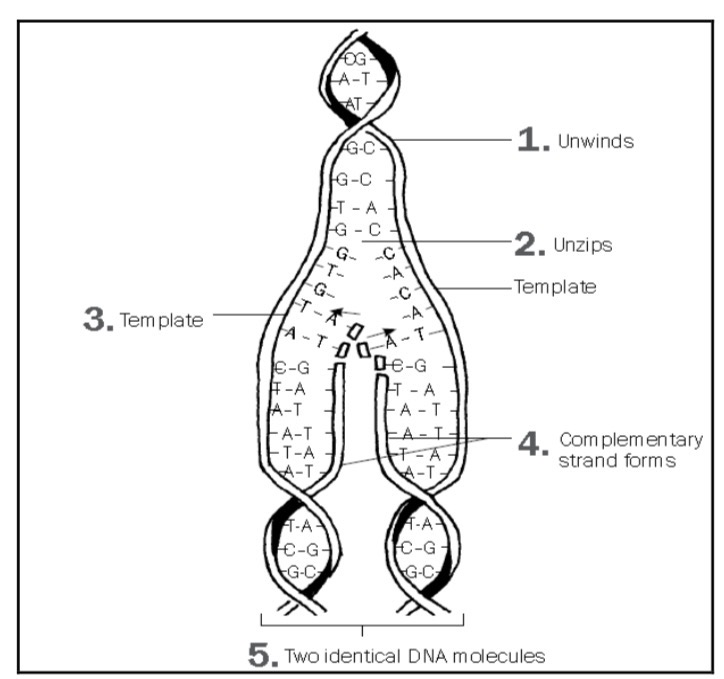
Diagram: DNA Replication
Screenshot
Process of DNA replication
DNA replication occurs in a specific sequence of steps. These steps must be written in the correct order to earn full marks.
Step 1: Unwinding of the DNA molecule
The DNA double helix unwinds.
This exposes the nitrogenous bases.
Step 2: Breaking of hydrogen bonds
The weak hydrogen bonds between the nitrogenous bases break.
As a result, the two DNA strands separate and unzip.
Learners lose marks if they describe strong bonds breaking.
Step 3: Template strands
Each of the original DNA strands serves as a template.
This means each strand is used as a pattern to build a new complementary strand.
Step 4: Formation of complementary strands
Free nucleotides present in the nucleoplasm attach to the exposed bases on each template strand.
Base pairing occurs as follows:
Adenine pairs with Thymine
Guanine pairs with Cytosine
This ensures accurate copying of genetic information.
Step 5: Formation of identical DNA molecules
Two identical DNA molecules are formed.
Each DNA molecule consists of:
One original (parent) strand
One newly formed strand
This is known as semi-conservative replication.
Learners lose marks if they state that both strands are newly formed.
Diagram of DNA replication
Diagram interpretation questions are common in examinations.
Distinction checkpoint
A learner who can:
State the functions of DNA
Define DNA replication accurately
Describe the process of DNA replication in the correct sequence
Explain how identical DNA molecules are formed
will be able to score full marks on DNA replication questions.
Significance of DNA replication
DNA replication is essential for growth, repair, and reproduction in living organisms. Its significance explains why DNA must be copied accurately before cell division.
Doubling of genetic material
DNA replication doubles the genetic material in a cell.
This ensures that:
Each new cell receives the same amount of DNA
Genetic information is maintained during cell division
Learners lose marks if they state that DNA replication halves genetic material.
Formation of identical daughter cells
DNA replication results in the formation of identical daughter cells during mitosis.
This is important because:
All daughter cells have the same genetic information
Cell functions remain consistent after division
Learners lose marks if they confuse mitosis with meiosis in this context.
DNA profiling
DNA profiling is a technique used to compare DNA samples and identify individuals based on their genetic material.
Uniqueness of DNA profiles
Every person, except identical twins, has a unique DNA profile.
This uniqueness allows DNA to be used reliably for identification purposes.
Description of a DNA profile
A DNA profile can be described as an arrangement of black bars.
These black bars:
Represent DNA fragments of a person
Form a pattern that is specific to that individual
Learners lose marks if they describe a DNA profile as the DNA sequence itself.
Uses of DNA profiling
DNA profiling can be used for several important purposes:
As proof of paternity
To trace missing persons
To identify genetic disorders
To establish family relations
To match tissues for organ transplants
To identify dead persons or animals
To identify crime suspects in forensic investigations
Correct use of terminology is required when listing applications.
Common errors made by learners in examinations
Learners often lose marks because they are:
Unable to answer and interpret questions based on the structure of DNA, DNA replication, and DNA profiling
Unable to make appropriate drawings and label diagrams correctly
Practising diagram drawing and interpretation is essential for examination success.
Distinction checkpoint
A learner who can explain the significance of DNA replication, describe DNA profiling accurately, list its uses correctly, and avoid common examination errors will be able to score full marks on questions related to these topics.